The challenge that teachers face with Communicative Language Teaching is the gap between its principles and classroom reality. CLT has been the dominant framework in English language teaching since the 1980s. It's in every teacher training course, every CELTA syllabus, every "modern" textbook. And yet, in classrooms around the world, the gap between CLT in theory and CLT in practice is enormous. Teachers know they should prioritise communication; they often default to grammar explanation anyway.
In 2026, CLT faces new pressures: AI tools that can provide infinite personalised input, research questioning whether "authentic communication" in classrooms is achievable, and a generation of students whose real communicative needs differ from what CLT was designed to address. The framework deserves an honest audit.
YapYapGo is a classroom speaking practice tool for ESL and EFL teachers built on the core CLT insight that production practice requires structured communicative tasks - not grammar drills. Here's what CLT gets right, where it overclaims, and what teachers should actually take from it.What CLT got right
Communication drives acquisition, not just demonstrates it. The foundational insight of CLT - that students learn language by using it, not just by studying it - remains one of the most robustly supported ideas in second language acquisition research. Swain's Output Hypothesis, Long's Interaction Hypothesis, and decades of classroom research all point to the same conclusion: speaking is an acquisition driver, not just an acquisition outcome. The affective filter is real. Krashen's concept - that anxiety blocks language processing - is not just intuitively true, it's neurologically documented. Students who feel safe produce more language. Students who feel watched and judged produce less. Any teaching method that lowers anxiety produces more learning, and CLT's emphasis on meaning over form tends to do exactly this. Authentic purpose matters. Students who are communicating for genuine reasons - to solve a problem, to persuade, to share information the other person actually needs - produce more complex and more accurate language than students performing exercises. The information gap research is clear on this. See our post on information gap activities for practical applications. Pair work is the most efficient format for speaking practice. This is now supported by enough research to be considered established rather than contested. In a class of 30, pair work multiplies individual speaking time by approximately 14 compared to teacher-led Q&A. The mathematics are simply compelling.Where CLT overclaims or gets complicated
"Authentic communication" in classrooms is largely fictional. Students know they are in a classroom practising a language for assessment purposes. The communicative scenarios they engage in are, at best, simulated authenticity. This doesn't make them worthless - simulated authenticity is a perfectly valid pedagogical device - but the stronger claims about CLT producing "real" communication in classrooms need tempering. Accuracy is not the enemy of fluency. Early versions of CLT were almost anti-grammar: the focus on meaning was so dominant that explicit grammar instruction was considered counterproductive. The research does not support this. Spada and Tomita's meta-analysis found that explicit grammar instruction alongside communicative practice produces significantly better outcomes than either alone. Modern CLT should embrace this. CLT is not a method - it's a set of principles. This is both its strength and its weakness. The principles (meaningful tasks, learner-centredness, communication as the goal) are robust. The absence of specific methodology means that "we use CLT" can describe anything from genuine task-based teaching to a grammar lesson with one communicative warm-up. The label obscures more than it clarifies. Not all learners benefit equally. CLT tends to work better for learners who are already comfortable in social situations, who have some baseline language, and who are in contexts where English has communicative relevance. It works less well for anxious learners, beginners with no productive vocabulary, and learners in contexts where English is purely academic. Context-sensitivity is the gap in most CLT accounts.Tool tip: YapYapGo implements CLT's core principles in a practical format: genuine communicative tasks (pair discussion with real information exchange), minimal teacher intervention during speaking, structured modes that scaffold without scripting. A conversation topic generator provides the communicative prompts; you provide the context and the feedback.
What CLT means in practice in 2026
The most useful distillation of CLT for a classroom teacher in 2026 is this:
Structure tasks around communicative goals, not grammar points. "Discuss your weekend" is not a communicative task - it has no goal. "Find out which of you has had the more interesting week, and be ready to explain why" is a communicative task - there's a decision to reach, a judgment to make, and a reason to listen carefully. Maximise student talking time, minimise teacher talking time. In a CLT-informed lesson, the teacher talks at most 30% of the time. In practice, most teachers talk 60-80%. Closing this gap is the single highest-leverage change any speaking teacher can make. See our post on reducing teacher talking time for specific strategies. Use form-focused feedback, but time it correctly. Don't correct during fluency activities. Save grammar feedback for the debrief. The distinction between fluency activities (where communication is the goal and form is secondary) and accuracy activities (where form is the focus) is one of the most practically useful legacies of CLT. Accept that "communicative competence" is a long-term goal, not a per-lesson outcome. CLT's real contribution is a curriculum philosophy, not a lesson technique. Individual lessons build towards the goal of communicative competence; they don't achieve it in 45 minutes. Pair work is not an optional extra. If your lesson doesn't include significant peer-to-peer speaking time, it is not a communicative lesson, regardless of the other activities. This is the one CLT principle that is both most important and most frequently violated.CLT and AI in 2026
The rise of AI conversation partners raises a legitimate question: if students can practise speaking with an AI at home, what is the role of classroom CLT? The answer is that AI provides input and feedback; it does not replicate the social, adaptive, and affectively complex experience of communicating with another human being.
A student who practises with an AI becomes better at speaking to AI. A student who practises with varied human partners develops the flexible, social, real-time communication skills that CLT was designed to build. The two are complementary, not competing. For the full argument, see our post on why classroom pair practice still beats AI chatbots.
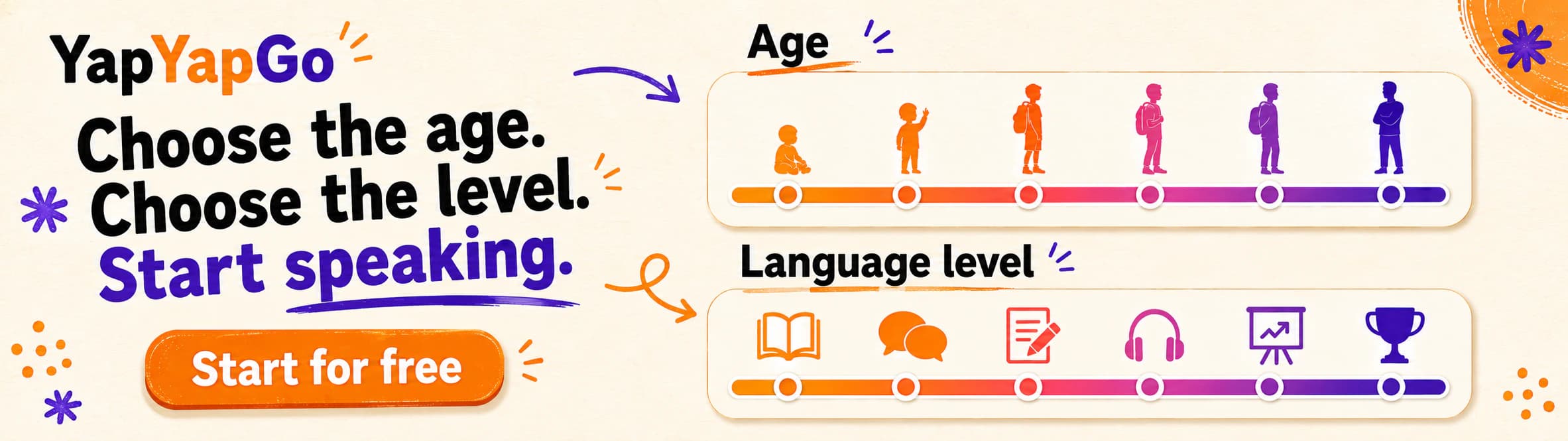
YapYapGo provides the structured pair work infrastructure that makes CLT practically viable in a class of 30: automatic pairing, levelled questions, and built-in timers. A random student picker for the debrief phase and an activity timer for each speaking round keep the communicative principle intact. Free to start.Sources:
- Hymes, D. (1972). On Communicative Competence. In Sociolinguistics, Penguin. - The original case for communicative competence as the goal of language teaching.
- Swain, M. (1985). Communicative Competence: Some Roles of Comprehensible Input and Comprehensible Output. Input in Second Language Acquisition. - Output as driver of acquisition.
- Spada, N. & Tomita, Y. (2010). Interactions Between Type of Instruction and Type of Language Feature. Language Learning. - Meta-analysis: explicit grammar + communicative practice > either alone.
- Long, M. (1996). The Role of the Linguistic Environment in Second Language Acquisition. Handbook of Second Language Acquisition. - The Interaction Hypothesis: the foundation for communicative pair work.
- Richards, J.C. & Rodgers, T.S. (2014). Approaches and Methods in Language Teaching (3rd ed.). Cambridge University Press. - CLT in historical and contemporary context.