← All posts
How to Monitor Speaking in a Class of 30 Without Losing Your Mind

How to Monitor Speaking in a Class of 30 Without Losing Your Mind

You've launched the pair work activity. Fifteen conversations are happening simultaneously. The noise level is healthy. Students are engaged. And you're standing at the front of the room, not quite sure what to do.

This is the problem nobody tells you about when they recommend pair work. Getting students speaking is the easy part. Knowing how to move through the room purposefully, what to listen for, what to note, what to intervene on, and how to give feedback at the end - that's the part that makes pair work genuinely effective rather than just busy.

YapYapGo is a classroom speaking practice tool that handles the pairing, timing, and question delivery automatically - which frees you completely to focus on what really matters during pair work: listening. Here's a practical system for doing that well.

The monitoring mindset shift

Most teachers approach pair work monitoring as supervision. Are they on task? Are they speaking English? Is anyone misbehaving?

That's the wrong frame. Monitoring is data collection. Every minute you spend circulating is an opportunity to gather specific, actionable information about your students' language that you'd never get from a whole-class lesson. The debrief at the end is only as good as the notes you took while walking around.

Shift your frame from supervisor to researcher, and your whole approach to monitoring changes.

A practical circulation system

With 15 pairs in a 45-minute lesson, you have roughly 15 minutes of pair work time. That's one minute per pair - just enough to hear a meaningful stretch of language if you move with purpose.

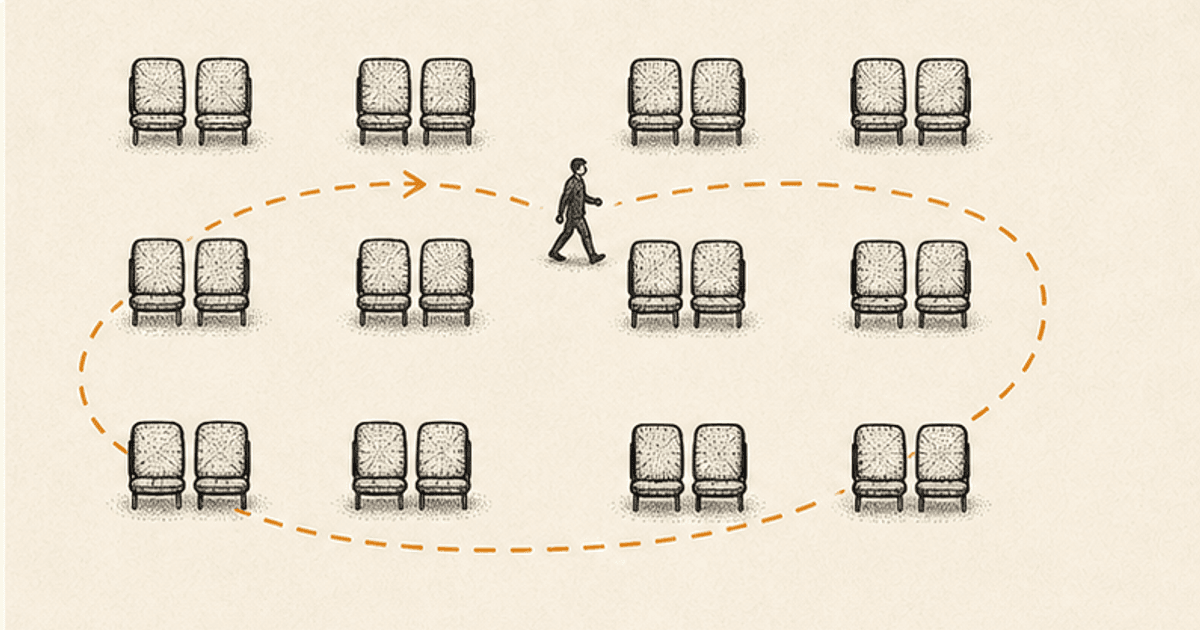
The route: Plan your path before you start. Don't drift. Move in a consistent pattern - either along rows or in a circuit - so you cover the whole room once. Resist the urge to hover near the pairs you're most interested in or most worried about. The stop: Pause behind each pair for 30-60 seconds. Don't stand in front of them - standing behind means they're less likely to stop speaking when they notice you. Make yourself invisible at the edge of their conversation. The focus: Listen for one thing per circulation. Not everything at once. On Monday, focus on fluency - are students speaking continuously or pausing frequently? On Wednesday, focus on vocabulary - are they using the target language from the previous lesson? On Friday, focus on task completion - are they actually addressing the question? The note: Carry a small notebook or use a notes app on your laptop. Note two or three specific examples - exact phrases students used, specific errors you heard more than once, vocabulary gaps that came up repeatedly. Concrete examples make your feedback meaningful. Vague observations ("some students struggled with tenses") are useless.
Tool tip: Because YapYapGo handles all the logistics - pairing, timing, question display - you can circulate from the moment pairs start talking. You're not managing a stopwatch or deciding who goes with whom. You're just listening. A classroom timer visible to the whole class keeps all pairs on the same schedule.

What to listen for

Fluency markers: Long pauses (more than three seconds), frequent filler sounds (um, uh, er), mid-sentence restarts, and loss of pace. These indicate automaticity hasn't developed for this language yet. Note which structures cause the most hesitation. Vocabulary gaps: When a student stops speaking and either switches to L1 or simplifies dramatically, they've hit a vocabulary ceiling. Note the gap - what word or phrase did they not have? This tells you what to pre-teach before the next activity on this topic. Grammar patterns: Don't try to catch every error. Listen for patterns. If you hear the same mistake from three different pairs, that's a teaching point. Single errors from individual students are less important and addressing them individually risks embarrassing the student in front of their partner. Task relevance: Are students actually discussing the question, or have they drifted to something else? Some drift is fine and signals genuine engagement. Complete derailment is worth a gentle redirect. Interaction quality: Is one student dominating? Is one student barely speaking? Are they taking turns? Are they responding to what their partner actually said, or just waiting to deliver their own prepared response? The interaction quality tells you as much about language development as the language itself.

When and how to intervene

The default is not to intervene. Interrupting a pair mid-conversation stops their flow, raises anxiety, and signals to other pairs that being overheard leads to being corrected. Students will start performing for you rather than communicating with their partner.

Reserve interventions for:

  • A pair that has gone completely off task and shows no sign of returning
  • A student who is genuinely stuck and getting visibly distressed
  • A moment where the whole class would benefit from a clarification

When you do intervene, whisper. Crouch to their level rather than standing over them. Frame it as a resource, not a correction: "Here's a phrase that might help: 'On the other hand...' - try using it in your next point." Then move on immediately.

The debrief that makes monitoring worthwhile

The four to five minutes at the end of a pair work activity is where your monitoring pays off. Without it, circulating is just eavesdropping. With it, it becomes targeted formative assessment.

Structure the debrief around what you actually heard:

Good language: "I heard someone say 'the flip side of that argument is...' - that's a great way to introduce a counter-point. Can whoever said it share what they were arguing?" This rewards language use publicly without singling out errors. Common gap: "I noticed lots of pairs struggled to express the idea of something being temporary versus permanent. Here are two phrases that would have helped..." Write them on the board. Interesting idea: "One pair had a really compelling argument that I want to share with the class..." This signals that you were genuinely listening to content, not just policing language.

Keep the debrief brief - three to five minutes maximum. Students have been speaking for 15 minutes and their attention is starting to drop. One or two focused points land better than an exhaustive analysis.

Tracking progress over time

A monitoring notebook becomes genuinely useful over several weeks. You can track whether specific students are developing fluency, whether vocabulary gaps are being addressed, and whether the same structural errors persist across lessons.

This isn't about building individual student dossiers. It's about identifying class-wide patterns. If the same fluency problem shows up week after week, something in your teaching sequence needs to change.

YapYapGo tracks which questions each class has already seen, which means you're always getting fresh conversations rather than rehearsed responses to familiar prompts. Combined with a consistent monitoring approach, it gives you the data you need to improve your teaching - not just fill your lesson time with speaking practice. Use a classroom timer to keep rounds consistent, a random student picker when calling on individuals to share. For the full case on why pair work is worth monitoring in the first place, see our post on why your students aren't speaking enough.
Sources:
  • Long, M. & Porter, P. (1985). Group Work, Interlanguage Talk, and Second Language Acquisition. TESOL Quarterly. - Pair work maximises speaking time and creates acquisition opportunities.
  • Sheen, Y. (2004). Corrective Feedback and Learner Uptake. Studies in Second Language Acquisition. - Intervention timing and type significantly affect uptake.
  • Ur, P. (1996). A Course in Language Teaching. Cambridge University Press. - Practical monitoring and feedback frameworks for communicative activities.

Ready to try it in your classroom?

YapYapGo is free to start — no account needed. Set up your first speaking session in under a minute.

Start for free →