Why debate works for language development
Debate is one of the few speaking activities that requires students to do several cognitively demanding things simultaneously: form an argument, anticipate a counter-argument, respond in real time, and manage all of this in a second language. That cognitive load is exactly what builds the kind of flexible, spontaneous language ability that exams test and real life requires.
Research on argumentation in language learning consistently shows that debate-format activities increase the use of complex grammatical structures, particularly conditionals ("If that were true, then..."), concession phrases ("I take your point, but..."), and modal verbs ("That might be the case, however..."). Students simply don't produce these structures in response to discussion questions - they only come out when there's something to argue for.
The format that works in a language classroom
The traditional school debate format - two teams, a moderator, formal turns - is too slow for language practice. Only a handful of students speak. Everyone else waits.
The format below scales to any class size because it runs as simultaneous pair debates.
Time: 20-25 minutes total
Group size: Pairs (always pairs, never teams)
Rounds: Three rounds, new motion each round, new partners each round
Step 1: Give the motion (1 minute)
Write or project the motion: "This house believes social media does more harm than good."
A clear "this house believes" format is better than an open question because it requires a position. Students can't sit on the fence.
Step 2: Assign sides (30 seconds)
Do not let students choose. Assign randomly - one person argues for, one against. This is non-negotiable for two reasons. First, it removes the social awkwardness of students having to publicly declare a position. Second, arguing a position you don't personally hold is actually better language practice - it forces students to think flexibly and use more abstract language.
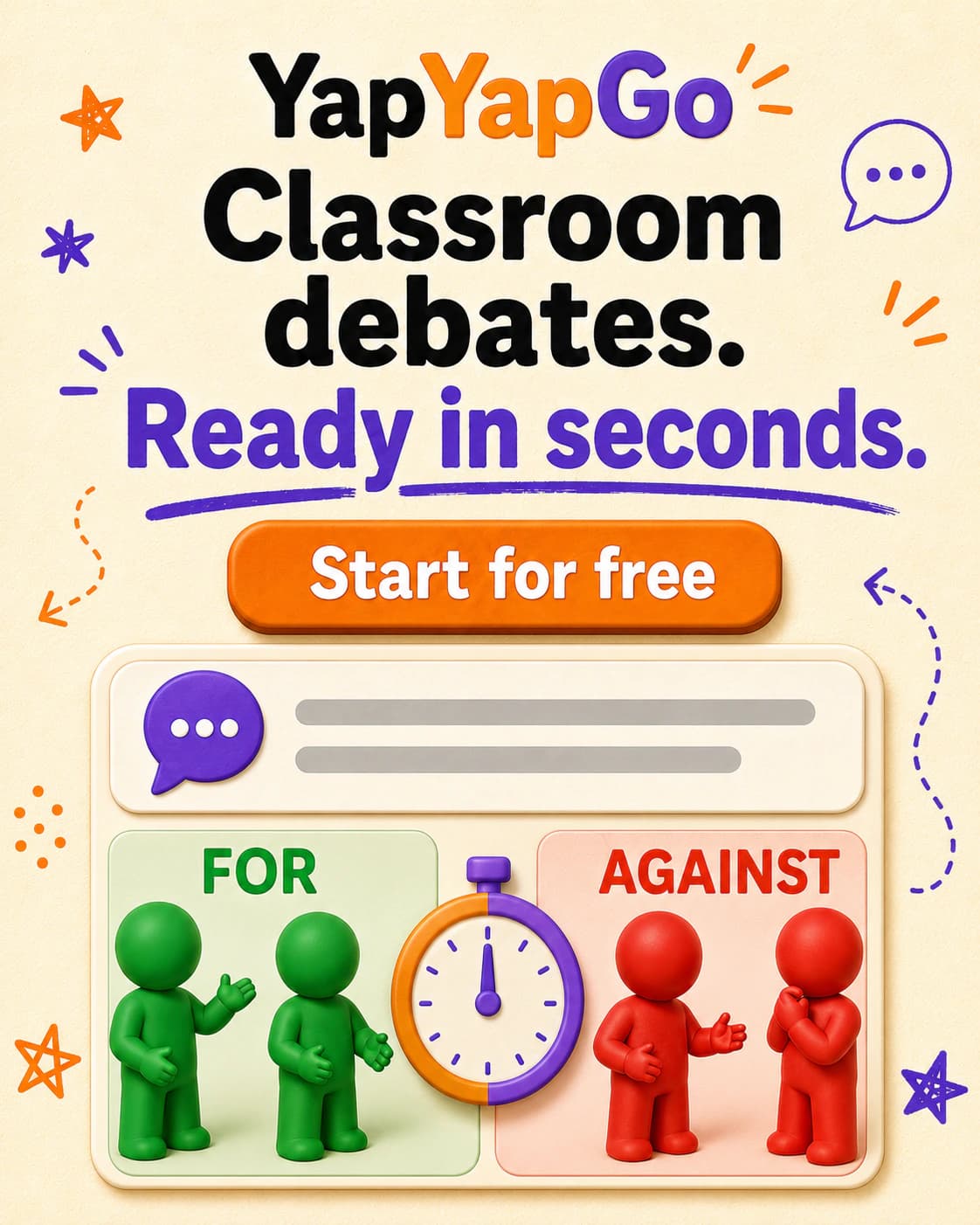
YapYapGo's Debate mode assigns sides automatically when you shuffle. Alternatively, a coin flip works fine. A
random student picker works well for this too.
Step 3: Preparation time (2 minutes)
Students prepare their arguments silently. Give them a simple framework to fill:
- Main argument (1 sentence)
- Supporting example or evidence
- Anticipated counter-argument from the other side
- Response to that counter-argument
Two minutes is enough. More than that and students start memorising speeches rather than preparing to argue.
Tool tip: YapYapGo's Debate mode includes a dedicated countdown timer for prep time, then automatically switches to speaking time - so you don't have to manage the clock. There's also a standalone debate timer if you just need the timing tool without the full platform.
Step 4: The debate (4 minutes per pair)
Student A presents their position: 60 seconds, uninterrupted.
Student B presents their position: 60 seconds, uninterrupted.
Free discussion: 2 minutes, both students responding to each other.
The structure in the first half is essential. Without it, the confident student talks over the less confident one and nothing useful happens. The 60-second uninterrupted rule forces both students to produce a full argument.
Step 5: Shuffle and repeat (twice)
After each round, shuffle pairs and give a new motion. Students now have a different partner and a different topic - but they can apply anything useful they heard or said in the previous round.
Three rounds is the sweet spot: enough variety to stay engaging, not so many that energy drops.
Step 6: Brief debrief (5 minutes)
Ask the class: what was the most convincing argument you heard today? What language did you use that you don't usually use? Write two or three phrases on the board from what you heard while circulating.
Keep the debrief short. Students have been speaking intensively for 15 minutes and their attention is starting to drop.