← All posts
Low-Prep Speaking Activities for the Overworked ESL Teacher

Low-Prep Speaking Activities for the Overworked ESL Teacher

You teach five classes a day. You have marking to do. You've got a meeting after school. And tomorrow's first lesson starts in twelve hours.

If this sounds familiar, you don't need a list of activities that require laminated cards, printed worksheets, and twenty minutes of setup. You need activities that work with nothing - or close to nothing - and still produce genuine speaking practice.

Here's the thing: the best speaking activities are often the simplest. A well-chosen question and a pair of students is all you need. The research backs this up - what drives fluency development isn't elaborate materials but high-volume practice with varied partners. That principle is exactly why YapYapGo exists. YapYapGo is a free classroom speaking practice tool with thousands of ready-to-use questions, automatic pair shuffling, and built-in timers designed for teachers who need zero-prep speaking activities. See also our 5-minute warm-ups for more ideas.

The one-tool solution

Before the activities, a practical suggestion: if you find yourself scrambling for speaking content multiple times a week, YapYapGo eliminates the problem entirely. It's a free classroom speaking practice tool with thousands of levelled questions, automatic pair shuffling, and built-in timers across six speaking modes. Open it at the start of class and you have an entire speaking lesson with zero prep.

That said, here are activities that need absolutely nothing.

Activities that need zero materials

The question swap

You provide one question. Students discuss in pairs for three minutes. Then you call "swap" - students change partners and discuss the same question again with someone new.

Why the repetition works: the second time students discuss a topic, they speak more fluently. They've already formulated their thoughts once, so the language comes out faster and more naturally. This is essentially the research principle behind the 4/3/2 technique - repeated production on the same content builds fluency.

The opinion line

Read a statement: "Money is more important than free time." Students who agree stand on one side of the room, students who disagree stand on the other. Then pair them across the line - one "agree" with one "disagree." Three minutes of discussion. New statement, rearrange, new pairs.

The physical movement adds energy, and the cross-opinion pairing guarantees genuine disagreement - which generates more language than agreement ever does.

Chain interviews

Student A interviews Student B for two minutes (any topic). Then Student B interviews Student C for two minutes. Then C interviews D. After three rounds, ask students to report what they learned about the person they interviewed - not about themselves. Forces active listening and third-person reporting.

The 30-second pitch

Give a topic: "Convince your partner to visit your hometown." Each student has exactly 30 seconds - no more. Partner gives feedback: "You convinced me because..." or "I wasn't convinced because..."

The extreme time limit forces students to prioritise and speak efficiently. It's also surprisingly fun - students get competitive about making the most persuasive case.

Prediction game

"What will be the biggest news story this week?" "What will your partner eat for dinner tonight?" "What score will [local football team] get this weekend?"

Students make predictions and explain their reasoning. Follow up next lesson - who was right? The follow-up creates continuity between lessons and gives students a reason to remember what was said.

Activities that need one piece of paper

Category brainstorm race

Write a category on the board: "Things you'd find in a kitchen." Pairs have two minutes to brainstorm as many items as they can, saying each one aloud (not writing). The pair with the most wins. Then discuss: "Which three are most essential?"

The brainstorm phase practises vocabulary retrieval at speed. The discussion phase practises opinion and justification. Together they cover both vocabulary and fluency.

The list debate

Write five items on the board: "loyalty, humour, intelligence, kindness, ambition." Students rank them individually (most to least important in a friend), then compare with their partner and defend their ranking.

Any list works: five qualities, five inventions, five countries, five skills. The content is secondary - the ranking and defending is where the speaking happens.

Question generator

Write three question starters on the board: "What would happen if...?" "Do you think...?" "Would you rather...?" Pairs create their own questions using these starters, then swap questions with another pair and discuss.

Student-generated questions often produce better discussion than teacher-provided ones because they target topics students actually care about.

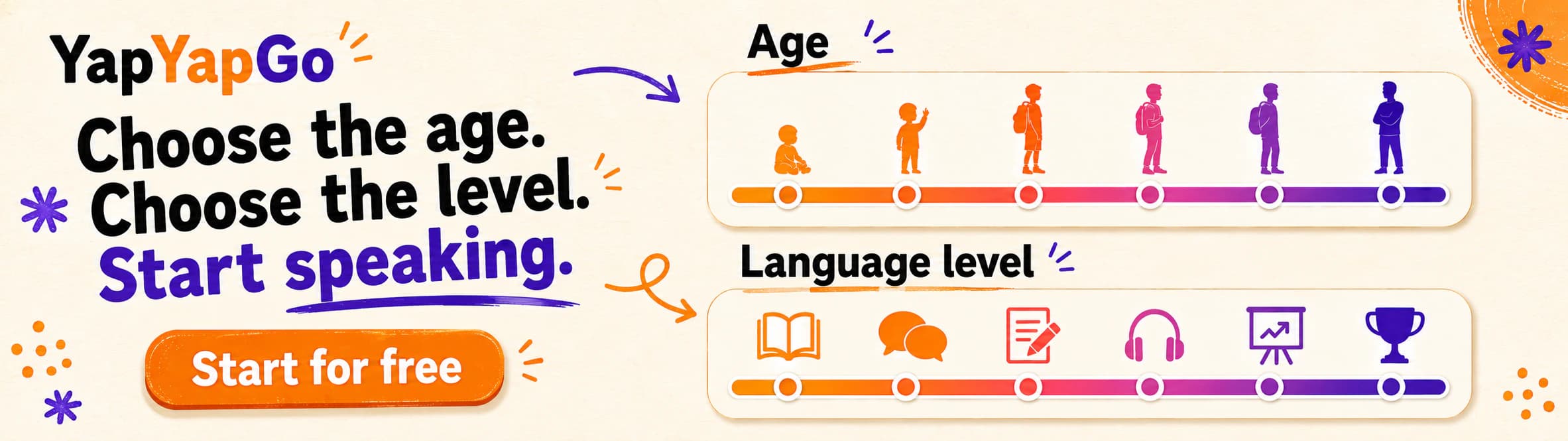
Tool tip: If even writing three things on a board feels like too much, YapYapGo has everything ready: discussion questions, debate motions, IELTS-style questions, timed talk prompts, and AI-generated questions - all levelled by age and CEFR. One tap gives you the next question. No board, no paper, no prep.

Why low-prep isn't low-quality

There's an assumption in teaching culture that more preparation equals better lessons. For grammar explanations and skills-based lessons, that's often true. For speaking practice, it's usually not.

The most effective speaking activities share three qualities: a clear prompt, a pair or small group, and enough time to talk. None of those require photocopies.

What matters is how many minutes each student spends actually producing spoken English. A simple question discussed in pairs for five minutes gives each student roughly 2.5 minutes of speaking time. A beautifully designed card-sorting activity that takes ten minutes to set up and five minutes to run gives the same 2.5 minutes - but cost you ten minutes of instruction time.

Simple scales. Elaborate doesn't.

The weekly speaking habit

If you're teaching 20+ hours a week, you can't prep elaborate speaking activities for every class. But you can build a habit: every lesson starts with five minutes of pair discussion on a single question. No prep needed. Five minutes per lesson, five lessons per day, five days per week = 125 minutes of additional student speaking time per week that costs you zero preparation.

YapYapGo makes this habit completely effortless. Open it, hit shuffle, and the question is on screen. Six modes, automatic pairing, thousands of questions that never repeat. Free to start - because overworked teachers shouldn't have to pay for the privilege of not prepping.

Free tools for your next lesson


Sources:
  • Nation, I.S.P. (1989). Improving Speaking Fluency. System. - Repeated practice on the same content builds fluency.
  • Long, M. & Porter, P. (1985). Group Work, Interlanguage Talk, and Second Language Acquisition. TESOL Quarterly. - Pair work maximises speaking time.
  • De Jong, N. & Perfetti, C. (2011). Fluency Training in the ESL Classroom. Language Learning. - Simple, repeated timed practice produces lasting gains.

Ready to try it in your classroom?

YapYapGo is free to start — no account needed. Set up your first speaking session in under a minute.

Start for free →