The most time-consuming approach to differentiating a mixed-level speaking class is also one of the least effective: producing different materials for different groups. You create a worksheet for A2 students and another for B2 students. You write simple questions for beginners and complex ones for advanced learners. You spend an hour preparing for every 20 minutes of speaking practice.
There's a better way. Open-ended speaking tasks - questions and scenarios designed so that the student's level of response determines the complexity of the output - eliminate almost all of this preparation while producing more genuinely differentiated practice than separate materials ever can.
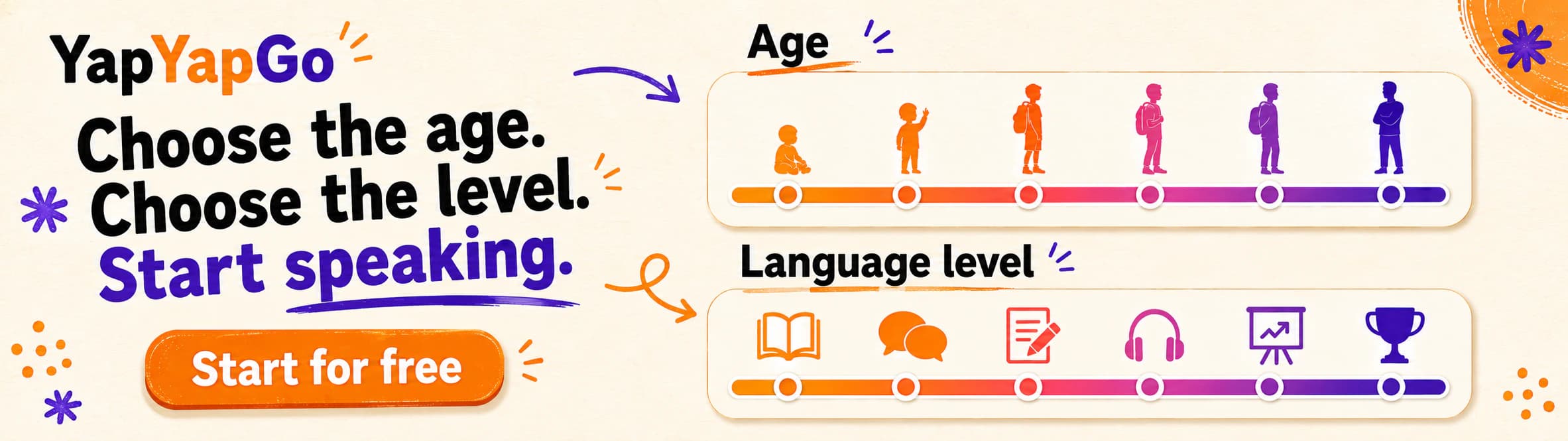
YapYapGo is a classroom speaking practice tool for ESL and EFL teachers with age-group and CEFR level filtering. But the principle of open-ended task design is something you can apply to any question or scenario. Here's how it works.What makes a task genuinely open-ended
An open-ended task has no ceiling on the complexity of a valid response. A student at A2 can give a simple, valid answer. A student at C1 can give a sophisticated, valid answer. Both are appropriate. Neither is wrong.
Compare these two questions:
Closed: "What are three advantages of living in a city?" (One correct type of answer; complexity is fixed by the question structure) Open: "Where would you rather live - a city or the countryside? Why?" (A2 answer: "I prefer the city because it is exciting and there are many shops." C1 answer: "I find myself drawn to the city partly for pragmatic reasons - career opportunities, cultural institutions, the density of social interaction - but I'm increasingly conscious of what urban living costs in terms of space, pace, and connection to the natural world.")Same topic. Same conversation. Completely different linguistic complexity determined by the student's capability.
The design rules for open-ended tasks
Rule 1: Personal and opinionable
Questions with a right answer are closed. Questions about personal preference, opinion, or experience have no single correct answer, so any valid response is acceptable. The student's level determines the sophistication of the response, not the question's difficulty.
Closed: "What is the capital of France?" (one right answer) Open: "Would you like to live in Paris? Why or why not?" (infinite valid responses)Rule 2: Scalable through extension
A good open-ended question generates a simple response at lower levels and extends naturally into more complex territory as the student develops. The structure doesn't need to change - just the student's output.
"What is a skill you'd like to learn?" generates:
- A2: "I want to learn to play guitar because it is cool."
- B1: "I'd love to learn photography. I think capturing moments is really meaningful and I could use it professionally."
- C1: "Photography, actually - but more specifically the way it requires you to train your eye to see what's normally invisible. There's something philosophical about deciding what deserves to be preserved."
Same question. Very different responses. No preparation change needed.
Rule 3: Topic-accessible without specialist knowledge
Lower-level students don't fail at open-ended tasks because of language - they fail because they have nothing to say about the topic. If the topic requires background knowledge they don't have, the task is effectively closed (only students with knowledge can participate).
Good topics for open-ended differentiation: personal experience, everyday preferences, things students observe in their own lives, simple social issues they've directly encountered. Poor topics: technical fields, historical events requiring detailed knowledge, current affairs students haven't followed.
Tool tip: YapYapGo generates levelled discussion questions across 20 topic areas. In a mixed-level class, you can use the same topic for all students but switch the CEFR level for each pair's questions - lower-level students get simpler versions of the same theme, higher-level students get abstract analytical ones. A classroom countdown timer keeps all pairs on the same schedule regardless of which question they're answering.
15 open-ended questions designed for maximum level range
These are designed so that an A2 student can answer them and a C1 student will still find them genuinely engaging. The same question, the same class, completely different language production.
- "What is something you changed your mind about recently? Why did you change it?"
- "If you had one extra hour every day, what would you do with it?"
- "What is a rule in your life that you live by? Where did it come from?"
- "Describe a moment when you felt very proud of yourself. What made it significant?"
- "What would be the ideal job for you? What makes it ideal?"
- "What is something you believe that most people around you disagree with?"
- "Describe the place where you feel most comfortable. What makes it feel that way?"
- "What is a skill that older generations have that younger people are losing?"
- "What has technology changed most significantly in your lifetime?"
- "If you could solve one problem in your community, what would it be and how?"
- "Describe someone who has influenced how you think. What did they teach you?"
- "What does success mean to you? Has your definition changed?"
- "What is something you find genuinely difficult that others seem to find easy?"
- "If your daily routine were a film genre, what genre would it be and why?"
- "What is a decision you made that you still think was right, even though it was hard?"
Each of these generates dramatically different responses at different CEFR levels while remaining accessible at A2 and genuinely stimulating at C1.
Using open-ended tasks with structured scaffolding
The only challenge with open-ended tasks is that lower-level students sometimes freeze in the face of an open question. The solution is not to close the question - it's to add a structural scaffold that gives students a way in.
The three-part scaffold: Provide a structure but not a script: "Give your opinion. Give one reason. Give one example." At A2, this structure is everything. At C1, students use it as a minimum and go beyond it. The preparation time: 60 seconds of silent preparation before every speaking task. Lower-level students use this to translate their thoughts into English. Higher-level students use it to organise more complex arguments. Both benefit equally. The sentence starter: For A2, provide one sentence starter: "For me, the ideal job would be... because..." The starter removes the blank-page problem without constraining what comes after it.For more on building scaffolding into speaking activities for lower levels, see our posts on scaffolding speaking for lower-level students and CEFR levels explained. A conversation topic generator surfaces open-ended discussion topics across levels without preparation. A random student picker keeps the sharing phase fair when calling on different level pairs to report their discussions.
Sources:
- Tomlinson, C.A. (2001). How to Differentiate Instruction in Mixed-Ability Classrooms. ASCD. - Open-ended tasks as the foundation of differentiated instruction.
- Foster, P. & Skehan, P. (1996). The Influence of Planning and Task Type. Studies in Second Language Acquisition. - Open tasks with planning time produce better output at all levels.
- Vygotsky, L.S. (1978). Mind in Society. Harvard University Press. - The ZPD: challenge slightly beyond current ability, not far beyond it.