Closed pairs: the default for speaking practice
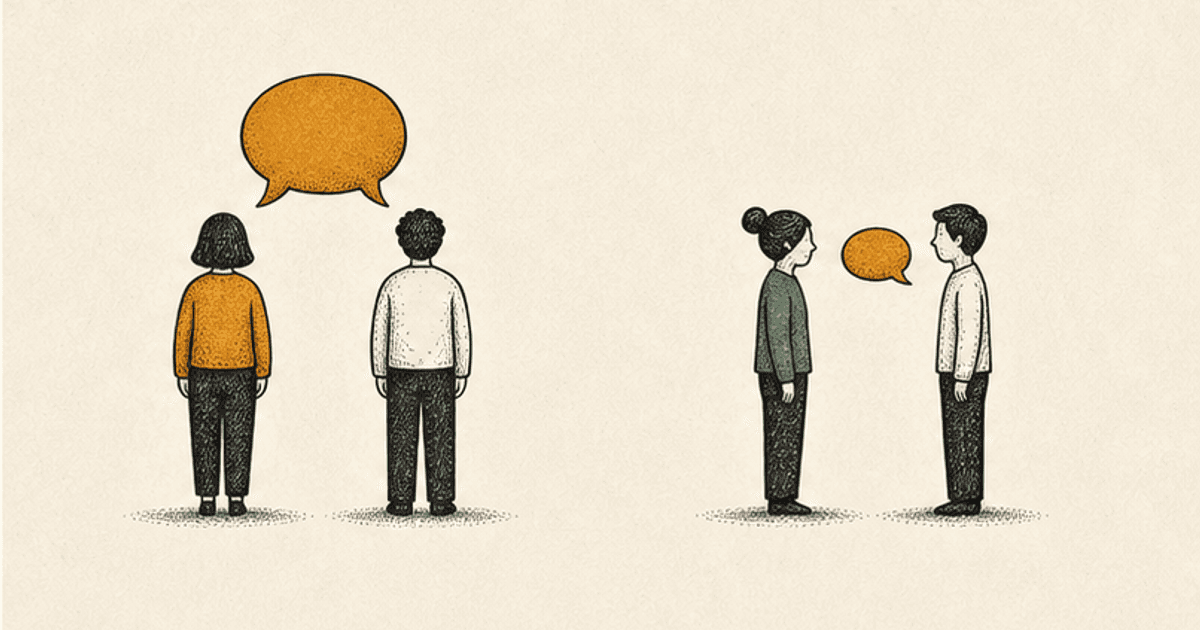
In closed pair work, all pairs work simultaneously. Every student speaks at the same time. The teacher circulates and observes.
Why this is usually better:
Every student produces language simultaneously. In a class of 30, closed pairs give every student 15+ minutes of speaking time per lesson. Open pairs give one student a minute while 29 wait.
Privacy reduces anxiety. Students who would freeze speaking in front of the class speak freely when only one partner is listening. The quality of language produced is often higher than in public formats.
Genuine interaction is possible. Pairs can take conversations in unexpected directions without the constraint of performing for an audience.
You observe more. Circulating during closed pair work gives you direct access to 15 conversations. Watching one open pair gives you access to one.
Open pairs: when they're worth it
Despite the limitations, open pairs are the right choice in specific situations.
Demonstrating a new activity format
When you introduce a new activity type - a role play students haven't seen before, a debate format, a collaborative task with a specific procedure - showing the class what successful completion looks like is more efficient than explaining it.
Select two confident students (this matters - open pairs for demonstrations should not involve anxious students). Have them perform the activity briefly. The class observes. Then everyone does it in closed pairs.
The demonstration function is the clearest case for open pairs. It saves 5 minutes of confused procedural questions.
Modelling target language
If you want to highlight specific language in use - a set of connectives, a register shift, a discourse management strategy - open pairs make the language visible to the whole class simultaneously.
Brief open pair demonstration (2-3 minutes), followed by class discussion of what specific language they noticed, followed by closed pair practice with that language as a focus. The open pair is a teaching tool, not the practice itself.
The fishbowl technique
Two students debate or discuss in the centre of the room while the remaining students form an outer circle observing with specific tasks: note one strong argument, note one phrase you'd like to use, note one moment where the conversation didn't quite work.
After the inner pair finishes, the outer circle discusses what they observed. Then the roles reverse: outer circle becomes inner, inner becomes observers.
This works because the observation has a specific purpose. Students in the outer circle are engaged and productive during the "watching" phase, not just waiting for their turn. For anxious students, seeing others navigate an activity reduces anticipatory anxiety.
Assessment contexts
When you need to assess specific students individually - for a grade, a progress report, or diagnostic purposes - open pair assessment allows you to observe one pair carefully with a rubric while the rest of the class works in closed pairs on an extension activity.
Don't run open pair assessment as a whole-class spectacle. Keep the assessed pair separate (at the back of the room, in the corridor, or in a section of the classroom) while the rest of the class works independently.
Tool tip: YapYapGo is built for closed pair practice - simultaneous pair work across the class while you circulate. The random pair rotation handles the logistics automatically. A classroom countdown timer marks round endings cleanly so transitions don't require open-pair-style whole-class attention.