← All posts
How Rotating Partners Keeps Speaking Activities Fresh and Inclusive

How Rotating Partners Keeps Speaking Activities Fresh and Inclusive

Three weeks into the term, you notice it. Students are gravitating to the same partners. The same pairs sit next to each other every lesson. The same groupings form when you say "find a partner." And the quality of pair work has plateaued - conversations are comfortable, but nobody is being challenged.

This is the static pair problem, and it affects almost every class that doesn't systematically rotate partners. The good news is that the fix is simple, the research backing it is strong, and the classroom dynamics shift within a few weeks. YapYapGo is a classroom speaking practice tool for ESL and EFL teachers with built-in automatic partner rotation between rounds - but you can rotate partners manually with nothing but a simple system.

Why fixed pairs undermine speaking development

Fixed pairs feel safe, and that's exactly the problem. When students always work with the same person, several things quietly go wrong:

Conversations become predictable. Partners learn each other's opinions, stories, and communication style. The effort of actually communicating - the negotiation, the clarification, the adaptation to a new listener - disappears. Students are exchanging familiar information with someone who already knows it. That's socialising, not language practice. L1 use increases. Students who share a first language and are comfortable with each other default to it under pressure. New partners - especially those who don't share L1 - make L1 unavailable or at least socially awkward. Dominance patterns solidify. In any fixed pair, a dominant speaker usually emerges within the first few weeks. That person gets more practice; the quieter partner gets less. Neither is being challenged. The room fragments. After a term of fixed pairs, many students have never spoken one-on-one with half the class. The room has become a collection of dyads rather than a community.

What rotation produces

The research on partner variation in second language acquisition is consistent. New partners create fresh acquisition opportunities because students have to negotiate meaning with someone who communicates differently. They encounter different vocabulary choices, different cultural references, different communication styles. They rephrase, clarify, adapt.

Long's Interaction Hypothesis describes this as one of the primary drivers of acquisition: the "pushed output" that happens when communication breaks down and students have to work harder to be understood. Fixed pairs, where communication almost never breaks down, provide very little of this.

Over time, classes that rotate consistently develop a noticeably different culture from classes that don't. Students who have spoken to everyone in the room arrive at pair work with a different mindset - they're not appraising a new partner, they're already comfortable with them.

Simple rotation systems for any class size

The row shuffle

Students sit in two rows facing each other. At the end of each round, one row shifts one seat to the right (the student at the end wraps to the other end of the row). New partner, every round, no logistics.

Works for: classes up to 30, rooms with traditional seating.

The inner/outer circle

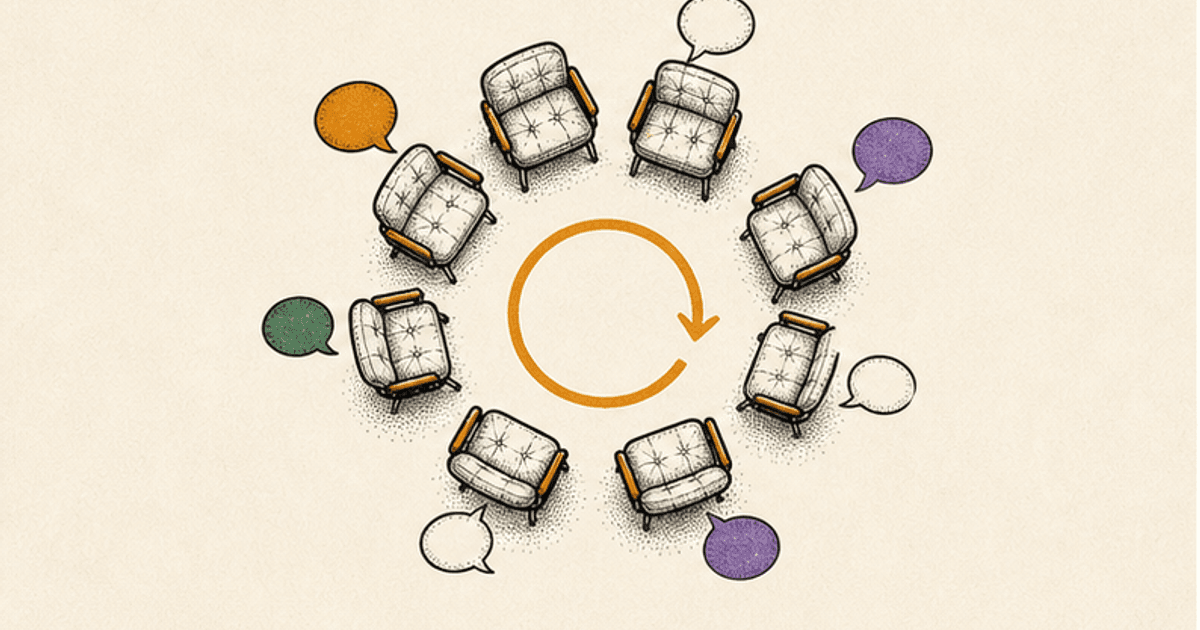
Chairs in two concentric circles. Outer circle rotates one chair clockwise after each round. Works well for smaller classes and gives a physical sense of movement that keeps energy high.

Works for: classes up to 24, rooms with moveable chairs.

The numbered system

Before the lesson, assign every student a number. Each round, you call two numbers to pair up: "1s with 6s, 2s with 7s..." A random student picker makes this genuinely random and adds a slot-machine moment students enjoy.

Works for: any class size, any room layout.

The card shuffle

Write each student's name on a card. Shuffle before each round. Draw pairs. Visible, fair, fast.

Works for: classes up to 35, any room layout.

Tool tip: YapYapGo handles partner rotation automatically between every round. Students can see the new pairing on screen immediately after the shuffle animation. Random, stretch, matched, or mixed modes - all with conflict avoidance rules if needed. The rotation takes five seconds and requires nothing from you.

Managing the resistance

Students resist rotation at first. They're used to working with their friends. The first week of systematic rotation produces slightly muted engagement as students adjust to working with unfamiliar partners.

Push through it. The research is clear that benefits emerge after three to four weeks of consistent rotation. After that point, working with anyone becomes the norm. Students who initially complained about random partners often become the most enthusiastic proponents once they've experienced more varied, energetic conversations.

You can reduce initial resistance by:

Making the rotation visibly fair. Random rotation is easier to accept than teacher-assigned rotation. "The algorithm decided, not me" removes the social politics of who is paired with whom. Framing it positively. "Today you'll get to speak to four people you haven't worked with recently" sounds better than "I'm changing your partner again." Running it consistently. Classes that rotate every lesson accept it as normal within two weeks. Classes that rotate occasionally never quite adapt.
Rotation and CEFR levels

One rotation question that genuinely requires thought: should you match levels or mix them when rotating?

For most activities, random rotation is fine - conversations self-level as students adapt to their partner. For timed fluency work, matched rotation produces better results because pace mismatches frustrate both partners. For open discussion activities, deliberate stretch pairing (rotating strong to weak) can work well if the activity structure protects equal contribution.

See our posts on stretch pairing vs matched pairing and CEFR levels explained for the full framework on choosing the right approach for different activity types.

YapYapGo supports all four pairing modes - random, stretch, matched, and mixed - and you can switch between them at any point in a session. A classroom group maker or random team maker helps if you need to create larger rotating groups rather than pairs.

The bottom line

Rotating partners is not just a logistical choice. It's a pedagogical one with direct consequences for how much language students produce, how hard they work to communicate, and how cohesive the class becomes.

The investment in the first few weeks of resistance pays back in more energetic pair work, less L1 drift, and a classroom culture where every student is genuinely comfortable speaking to every other student. That's worth the awkwardness of the first rotation.


Sources:
  • Long, M. (1996). The Role of the Linguistic Environment in Second Language Acquisition. Handbook of Second Language Acquisition. - New partners force negotiation of meaning, driving acquisition.
  • Storch, N. & Aldosari, A. (2013). Pairing Learners in Pair Work Activity. Language Teaching Research. - Interaction dynamics matter more than proficiency matching.
  • Liljedahl, P. (2014). The Affordances of Using Visibly Random Groups. In Transforming Mathematics Instruction, Springer. - Three to four weeks for random grouping to become normalised.
  • Mackey, A. (1999). Input, Interaction, and Second Language Development. Studies in Second Language Acquisition. - Varied interaction accelerates acquisition more than repeated practice with the same partner.

Ready to try it in your classroom?

YapYapGo is free to start — no account needed. Set up your first speaking session in under a minute.

Start for free →