Why students dry up
The question is too broad. "Discuss technology" gives students nothing to grab onto. There are a thousand possible entry points and no obvious one. The cognitive load of deciding
what to say crowds out the ability to say it.
The question is too easy. "Do you like pizza?" produces "Yes" and then silence. There's no disagreement, no complexity, no reason to keep talking.
They've exhausted their vocabulary. The student has an opinion but lacks the words to express it. Rather than struggle publicly, they stop.
They've said their piece. Some questions genuinely only need a short answer. "What time do you wake up?" doesn't naturally generate five minutes of discussion.
The pair dynamic is flat. Two passive students paired together produces silence faster than any bad question.
Seven fixes that work immediately
1. Use specific, opinion-based questions
Replace vague topics with specific questions that require a position and a justification.
Instead of "Discuss education," try: "Do you think homework should be abolished? Why or why not?" The student knows exactly what's expected, can form an immediate opinion, and has a natural structure for their response.
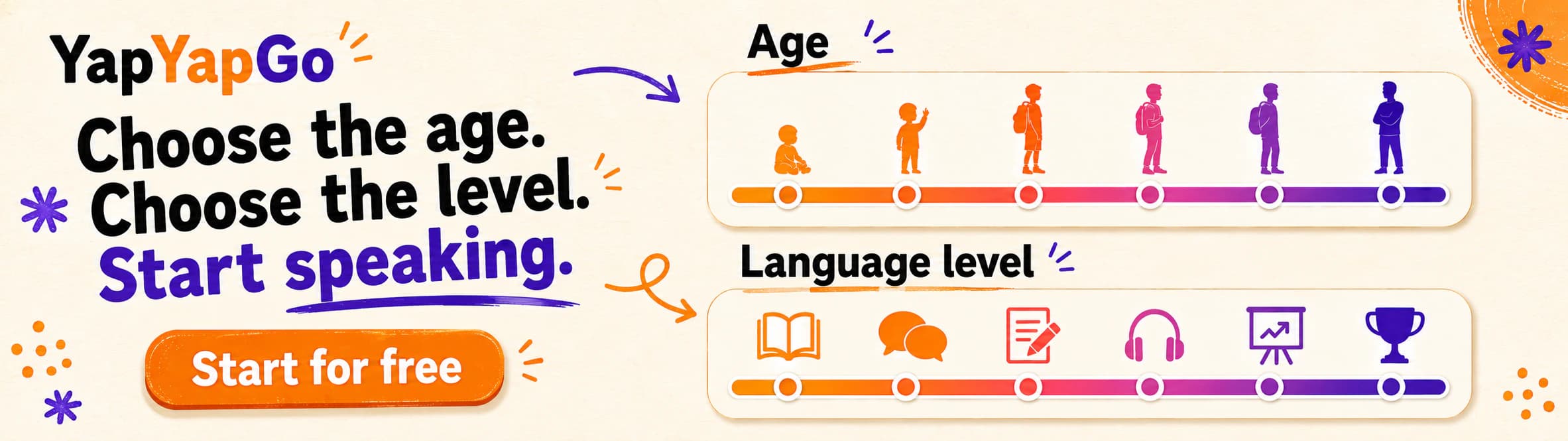
YapYapGo has thousands of specific, opinion-based discussion questions across ten topic categories, all matched to CEFR level. The questions are designed to generate extended responses, not one-word answers. Open it, shuffle, and the question is on screen.
2. Teach the follow-up question
The biggest reason conversations die is that neither student asks a follow-up question. Student A gives their answer. Student B nods. Silence.
Train students to ask at least one follow-up question after every answer: "Why do you think that?" "Can you give an example?" "Has that always been your opinion?" "What would change your mind?"
Post a list of five generic follow-up questions on the wall. Refer to it before every speaking activity. Within two weeks, follow-up questions become automatic.
3. Layer the questions
Instead of one question for five minutes, give three questions of increasing depth for the same five minutes.
Round 1 (concrete): "What do you usually eat for breakfast?"
Round 2 (opinion): "Do you think people in your country eat healthily?"
Round 3 (abstract): "Should governments regulate what food companies can sell?"
Students work through them at their own pace. Fast pairs reach the abstract question. Slower pairs spend more time on the concrete ones. Nobody runs out of things to say because there's always a next question.
Tool tip: YapYapGo displays a new question at the touch of a button - so when a pair finishes, you can serve the next one instantly. The question bank tracks what's been used, so you never accidentally repeat.
4. Give thinking time
Students dry up partly because they're processing two things at once: what to say and how to say it in English. Even 30 seconds of silent thinking time before the activity starts reduces this overload significantly.
Research consistently shows that planning time improves both fluency and complexity of output. It also reduces anxiety, which further removes the block.
5. Provide vocabulary scaffolding
If students keep hitting vocabulary walls on a topic, give them five key words before the activity starts. Write them on the board. Don't explain them in detail - just make them available.
"Today we're discussing health. Here are five words you might need: sedentary, chronic, prevention, wellbeing, nutrition." Students who were going to say "sitting a lot is bad" now have access to "a sedentary lifestyle" - and the conversation goes deeper.
6. Rotate partners
Sometimes the problem isn't the question - it's the pair. Two shy students together produce silence. A student paired with someone they find intimidating produces silence. A student paired with their best friend produces L1.
Rotating partners after every round solves all three problems. New partners bring new energy, new perspectives, and a fresh social dynamic.
YapYapGo shuffles pairs automatically between rounds - random, stretch, matched, or mixed modes. The shuffle takes five seconds and eliminates the logistics of manual rearrangement.
7. Model the extended answer
Before the activity, answer the question yourself - out loud, in front of the class. Show them what a 60-second answer sounds like. Show them how you extend: give your opinion, add a reason, provide an example, consider the other side.
Students who've just heard a model are far more likely to produce extended answers themselves. They have a template in their head.