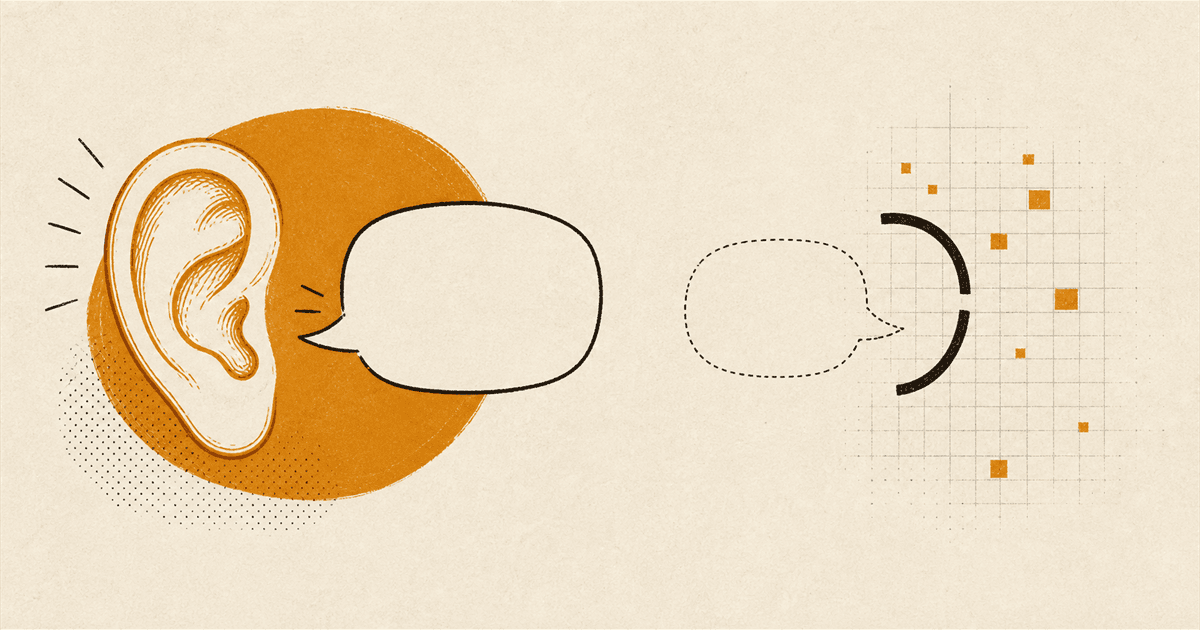
The challenge with AI ESL tutors is that they generate plausible English speech but they don't listen the way a human listener listens. Conversation is half listening, and the half that AI does well is the small narrow half - parsing words. The half it doesn't do is the half that drives language acquisition.
This isn't a near-future fix. It's a structural limitation of how AI systems process input versus how human listeners process input. The gap matters for ESL teachers because the listening half of conversation is where the learning happens.
YapYapGo is a classroom speaking practice tool for ESL teachers, designed around pair conversation between actual humans rather than student-to-AI dialogue. This post is about why the listening capacity of real classmates is irreplaceable, and what that means for AI's role in your stack.What "listening" means in conversation
When two humans have a conversation, the listener is doing far more than parsing words. They're processing:
- Hesitation. Did the speaker pause unusually? Were they searching for a word?
- Confusion. Did the speaker's expression shift? Did they look down? Did their pitch change?
- Half-meaning. Did the sentence stop short of what they meant?
- Gesture and eye contact. Are they showing me they're stuck?
- Pragmatic intent. Did they mean what they said literally, or are they joking, hedging, being ironic?
- Cultural register. Are they being formal because they're nervous, or because the topic calls for it?
This is what language teachers mean by listening, and it's the listening that drives acquisition. When a classmate notices that another student is struggling for the word "embarrassed", they say "embarrassed?", and the student picks it up. That's uptake. Schmidt's noticing hypothesis (1990) and Long's interaction hypothesis (1996) both centre on this moment. It's the engine of vocabulary acquisition.
What AI listens to
AI tutors do speech-to-text, then process the text. The pipeline:
- Audio comes in.
- Speech recognition converts it to text.
- Text gets processed by the language model.
- The model generates a response.
- Text-to-speech delivers the reply.
Each step throws away information. The audio's hesitation gets discarded in transcription. The pauses are normalised. The visual cues don't exist (most AI tutors are voice-only). The pragmatic and cultural register has to be inferred from text alone.
What survives the pipeline is roughly: "what words did the student say". This is genuine listening of a kind, and it's useful for some narrow purposes. It's not the listening that humans do, and it can't be the listening that drives the acquisition moments described above.
The smoothing problem
AI tutors are tuned to be conversational and helpful. When a student says something half-formed, the AI smooths over it - infers what was meant, replies as if the student had been clear, keeps the dialogue moving.
This feels nice. It produces conversation. It also kills the negotiation of meaning that drives acquisition.
Imagine a real-world example. A student says "I went to the... uh... the place where the food is". A human listener might say "the restaurant?" or "the supermarket?" - forcing the student to specify and incidentally giving them the missing word. An AI tutor, optimised for fluid conversation, is likely to infer "restaurant" and continue: "That's great! What did you eat there?" The student got their unspecific sentence accepted, didn't need to repair, didn't learn the word.
Across a term of AI tutor practice, this pattern means thousands of missed acquisition moments. The student feels fluent. They're getting almost no uptake.
Why classmates do this better
A real classmate in a pair-work activity:
- Hears the hesitation and reacts to it. Asks the speaker to clarify, supplies a guess, looks confused.
- Notices when meaning didn't land. Asks "do you mean X?" or just looks puzzled.
- Brings their own gap. A classmate doesn't have perfect English either, so they're constantly negotiating meaning from both sides.
- Is socially present. The speaker knows the listener is real, which raises the stakes and motivation in productive ways.
These features are structural to human classmates and largely absent from AI tutors. They're also what the research literature identifies as the conditions for acquisition.
This is the same lever the broader Willingness to Communicate research is pulling on - the social presence of the listener changes what the speaker produces. AI tutors are present but not socially present in the way that drives learning.
You can build classroom sessions that maximise these listener effects with the Team Maker for fast pairing, the Topic Generator for prompt variety, and the Classroom Timer for managing rounds. The pair-work format puts every student in the listener role half the time, which is where their acquisition gains come from.
Where AI listening is actually useful
This isn't an argument for never using AI listening. AI listening earns its place for specific narrow tasks:
- Pronunciation feedback. AI can spot segmental and prosodic errors and provide immediate response. This is genuine value.
- Transcription practice. Students can speak and see the AI transcribe; mismatches show them what isn't being clearly produced.
- Asynchronous self-study. Students who want to practise between classes have AI listeners available.
- Intelligibility training for international communication. Practising being understood by a system that doesn't share your L1.
What AI listening shouldn't do is be the main conversational partner for an ESL student. The smoothing problem and the structural absence of social-cue processing make AI a poor stand-in for human classmates in the activity that actually builds conversational competence.
The complementary patterns to read are the predictability trap in AI conversation, the accent variety gap in AI listening, and the slang and idiom gap. Together they map the same structural picture: AI does narrow well, broad poorly.
The bottom line
Conversation is half listening, and AI tutors do only the narrow half. The half that drives acquisition - noticing confusion, repairing meaning, supplying words - is a structural feature of real human classmates. Use AI for pronunciation feedback and asynchronous drilling. Use classroom pair work for the listening that actually teaches.
Sources:
- Schmidt, R. (1990). The role of consciousness in second language learning. Applied Linguistics.
- Long, M. H. (1996). The role of the linguistic environment in second language acquisition. Handbook of Second Language Acquisition.
- Mackey, A. (2007). Conversational Interaction in Second Language Acquisition. Oxford University Press.