The challenge that prevents many ESL teachers from running effective pair work is not the activity itself - it's the arrangement of the room. Most classrooms are set up for one activity: the teacher standing at the front while students face them in rows. This arrangement optimises for transmission - teacher to students. It is the worst possible arrangement for speaking practice.
When students are arranged to face the teacher, pair discussion becomes awkward. Partners who need to speak to each other have to turn sideways, speak across a desk, or speak at an angle to someone who is fundamentally oriented towards the front. The physical posture communicates that the real action is at the front, and pair work is an interruption to the normal flow.
Changing the seating arrangement changes the pedagogy. YapYapGo is a classroom speaking practice tool for ESL and EFL teachers that handles the pair rotation and question delivery. But the physical arrangement of the room determines whether pair work feels natural or awkward. Here's what works.
The two fundamental principles
For speaking practice, students should face each other - not the teacher. When students face each other, pair discussion is the default mode. The physical orientation communicates: talking to each other is what we do here. When students face the teacher, pair discussion feels like a deviation from the normal. Arrangement should enable movement without chaos. Partner rotation is one of the most effective tools in a speaking classroom. If the room arrangement makes rotation difficult or slow, teachers avoid it. If rotation is quick and clear, it becomes a regular part of every lesson.Arrangements that work for pair work
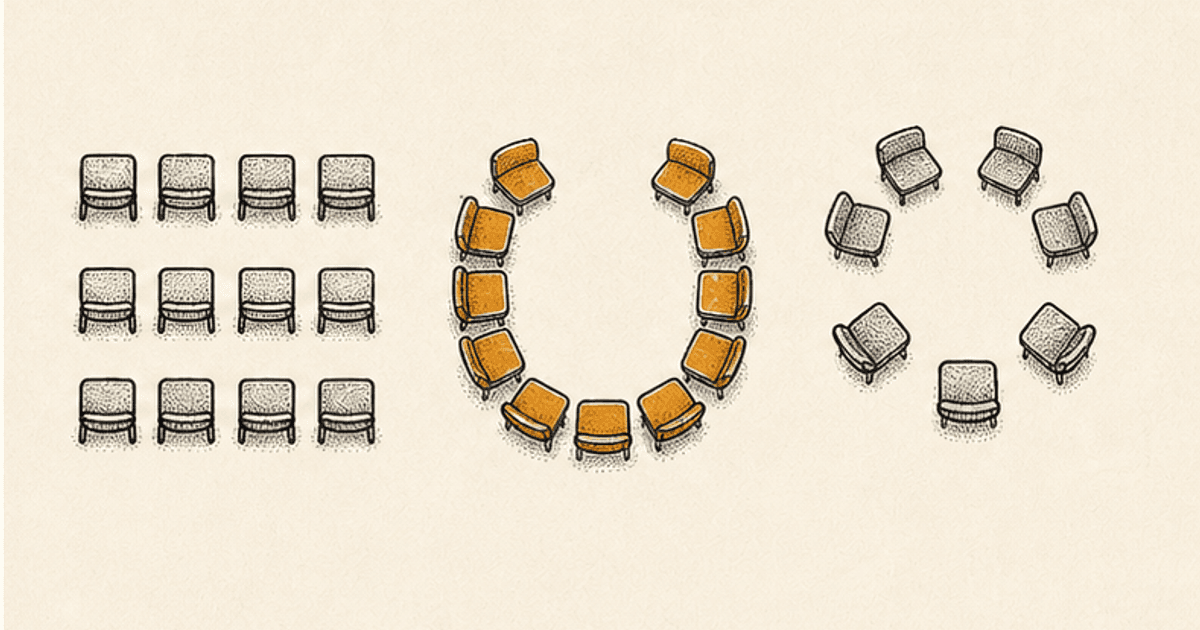
The horseshoe (U-shape)
The most versatile arrangement for a speaking-focused class. Students sit in a U-shape facing inward. For pair discussion, they turn to the person next to them. For whole-class discussion, everyone can see everyone. For partner rotation, students on one side of the U rotate one seat.
Best for: Classes of 16-28 students, rooms with moveable chairs, mixed pair and whole-class activities. Limitation: Does not work well for very large classes (above 30) - the U becomes too wide for students at opposite ends to hear each other.The double rows facing each other
Two rows of chairs facing each other, approximately one metre apart. For pair work, each student speaks to the person directly across from them. For rotation, the students in one row move one seat to the right (with the person at the end wrapping to the far position).
This produces the most efficient rotation of any seating arrangement - partner change takes under 20 seconds with no furniture movement.
Best for: Speaking-intensive lessons, IELTS practice, speed conversation activities. Less suited to lessons with significant teacher-led phases.The cluster arrangement (groups of 4)
Tables or chairs in clusters of four. Within each cluster, students pair with the person opposite or next to them. Between clusters, rotation can happen by one student from each cluster moving to the next.
Best for: Activities that alternate between pair and group work. Group tasks become easy because the groups are already formed. Limitation: Noise management is harder when clusters are close together. Allow space between clusters where possible.The café layout
Tables for two, arranged throughout the room. Each table is a pair. For rotation, one student from each table stands and moves to the next table clockwise.
Best for: Speed conversation activities, longer pair discussions, adult classes where individual space matters.The traditional row (adapted)
If the room has fixed furniture, turn desks diagonally so each student faces slightly towards their neighbour rather than squarely at the front. In rows, this makes pair discussion with the person next to or diagonally behind you more natural.
For classes with completely immoveable furniture: Use explicit pair designations so students know who their partner is before the activity. "Your partner is the person two seats to your left." Clear designation eliminates the awkward physical negotiation of who works with whom.Tool tip: YapYapGo handles the partner matching digitally - students know who they're paired with from the shuffle display on screen. In a classroom with the double-row or horseshoe arrangement, this pairing display works beautifully alongside the physical setup. A classroom countdown timer visible at the front of the room keeps all pairs on the same schedule regardless of where they're sitting.
Acoustics and noise management
The arrangement of chairs affects noise levels significantly. Students who are further apart speak more loudly to be heard. Students who are too close lower their voices to maintain conversational privacy.
Optimal pair distance: Approximately 60-80 centimetres between speaking partners. Close enough for quiet conversation; far enough that neither student is reading the other's notes. Cluster spacing: Leave at least one metre between clusters. The space allows each cluster to function as a semi-private acoustic zone without sound bleeding completely into neighbouring groups. Hard floors vs. carpeted: Hard floors reflect sound dramatically. In a classroom with hard floors and 30 students speaking simultaneously, noise can become a management problem. If you have any control over the environment, position pairs along walls or use soft furnishings where available to absorb sound. See our post on noise management during speaking activities for strategies when the acoustics are genuinely difficult.Getting students to rearrange quickly
The main barrier to non-standard seating is the time it takes to rearrange. Two minutes of furniture movement eats significantly into a 45-minute lesson. Three strategies help:
Establish a default alternative arrangement. At the start of term, teach students your standard "pair work arrangement" and practice moving into it. "Pair position" should take under 60 seconds once it's routine. Use partial rearrangement. Rather than moving the whole room, move only what's necessary. Turn every other row to face backwards. Pull the first two desks from each row together. Minor changes that take under 30 seconds. Use the room as it is, with explicit pairing. In a fixed-row classroom, designate partners in advance using the random student picker. Students turn to face their designated partner without moving furniture. Not ideal, but workable.Making the arrangement permanent
In classrooms you use repeatedly, the optimal approach is to set the room in the pair work arrangement at the beginning of term and keep it there. This signals - every lesson, without words - that this is a speaking class where talking to each other is the default.
Students often resist this at first. A classroom that doesn't look like a classroom can feel unfamiliar. After two or three lessons, the horseshoe or double-row arrangement feels normal. After four or five, students notice if it's different.
For more on building the class culture that makes speaking activities work, see our posts on why random grouping beats teacher-assigned pairs and how rotating partners keeps speaking activities fresh. A random team maker helps when you want to form larger groups from within whatever seating arrangement you're using.
Sources:
- Leikin, R. & Zaslavsky, O. (1997). Facilitating Student Interactions in Mathematics. Journal for Research in Mathematics Education. - Physical arrangement as a driver of student interaction patterns.
- Dörnyei, Z. & Murphey, T. (2003). Group Dynamics in the Language Classroom. Cambridge University Press. - The classroom environment as a determinant of participation.
- Long, M. & Porter, P. (1985). Group Work, Interlanguage Talk, and Second Language Acquisition. TESOL Quarterly. - Physical proximity and interaction quality in L2 classrooms.