The four corners activity solves a problem that most speaking activities don't even try to address: the physical inertia of the language classroom. Students who have been sitting in chairs for 30 minutes are physiologically different from students who have just moved across a room to stand with people who share their view. Movement changes energy. Energy changes speaking.
Four corners is also one of the most inclusive debate formats available. It doesn't require students to construct long arguments from scratch. It asks them to commit to a position, explain it simply, and listen to someone who disagrees. That's accessible at B1 and genuinely interesting at C1.
YapYapGo is a classroom speaking practice tool for ESL and EFL teachers. Four corners generates the opinion positions; pair work between rounds generates the extended speaking practice. Here's how to run it well.The format
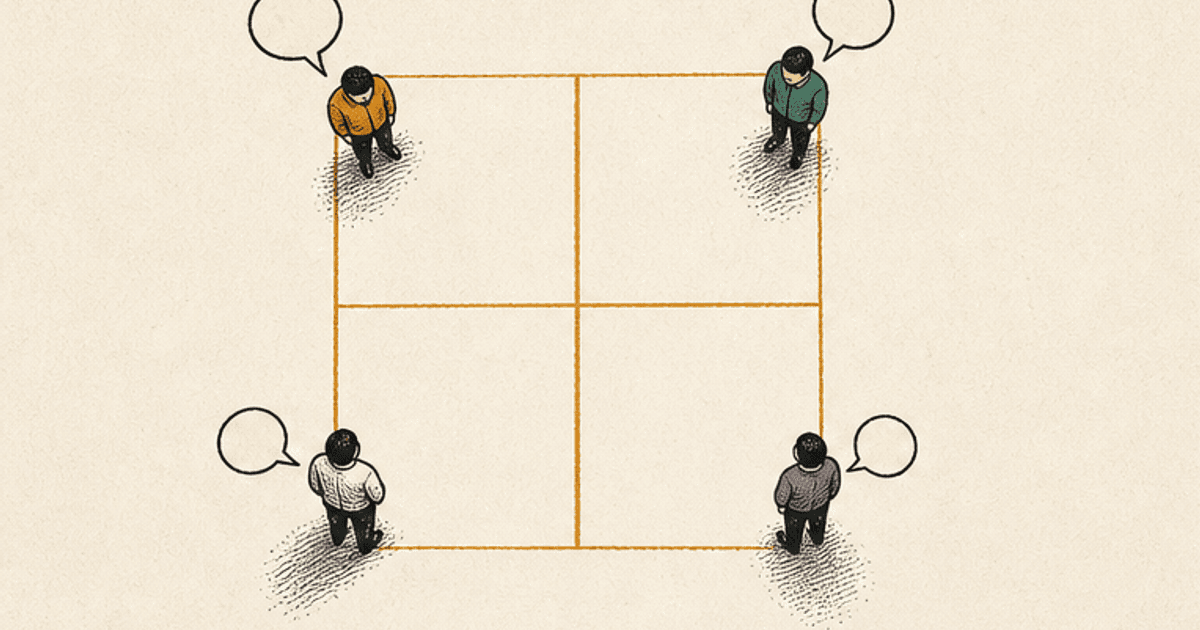
Setup: Designate four corners of the room with labels (physical cards, written on the board, or just verbally announced):- Strongly agree
- Agree
- Disagree
- Strongly disagree
A full four corners sequence with one statement takes approximately eight minutes. Two or three statements fills a 25-minute activity block.
Why the "no neutral" rule matters
The single most important design feature of four corners is the absence of a middle ground. "It depends," "I'm not sure," and "both sides have a point" are intellectually honest positions on many questions but they produce zero speaking practice. They allow students to avoid the cognitive and linguistic work of committing to an argument.
When students are forced into a corner - sometimes quite literally - they produce language they wouldn't produce from a safe, hedged position. The discomfort of having to defend a position you hold with 60% conviction is exactly what generates interesting language. It's also much closer to real-world communication, where you rarely have the luxury of perfect certainty.
If a student genuinely cannot place themselves in any corner, the structure to give them is: "Which corner are you closest to? Stand there and explain the gap."
Choosing statements that work
The best four corners statements share three characteristics:
They are clear enough to commit to. Vague statements produce confused positioning. "Progress is complex" cannot be strongly agreed with. "Economic growth always comes at an environmental cost" can. They produce genuine disagreement. If 90% of students end up in the same corner, the discussion collapses. Statements should be chosen to split the room. Test them mentally: can you construct a strong argument for each corner? If not, the statement is too obvious. They are relevant without being personally sensitive. Topics like inequality, technology, education, and environment produce strong opinions without touching on students' own identities in ways that might cause genuine discomfort.Statement bank by level
A2-B1 (concrete and personal):- "Homework should be banned in schools."
- "Money is more important than happiness."
- "People should have to pass a test before they can use social media."
- "Zoos should be closed."
- "Everyone should learn to cook."
- "Cars should be banned from city centres."
- "Parents should choose their children's career."
- "Social media has made people more politically polarised."
- "A four-day working week would benefit society."
- "Climate change is the most important issue of our generation."
- "Schools spend too much time on academic subjects and not enough on life skills."
- "Immigration makes countries stronger."
- "Fame does more harm than good to the people who achieve it."
- "The richest people in society should pay more than 50% of their income in tax."
- "Freedom of speech must include the freedom to cause offence."
- "Progress is impossible without inequality."
- "Democracy is the least bad system of government, not a good one."
- "Individual choices cannot solve structural problems."
- "Economic growth and environmental sustainability are fundamentally incompatible."
- "The purpose of education is to serve the economy, not the individual."
Tool tip: After the main four corners activity, run a structured pair debate using YapYapGo's Debate mode on the statement that generated the most movement and argument. Students now have developed positions, vocabulary, and partner familiarity. The debate timer structures the follow-up pair discussion efficiently.
Variations
Four corners with evidence: Before positioning, give students two minutes to think of one real example that supports their view. They must use this example in their corner discussion. The double four corners: Run the same statement twice with the same students - once arguing their genuine view, once arguing the opposite. Higher levels only. The reversal forces students to understand the other side more deeply. The shifting sands: After each share-and-challenge, give students 30 seconds to reconsider before repositioning. Run two or three rounds of repositioning before moving to a new statement. Tracks how arguments change views in real time. The silent positioning: Students move to their corner without speaking. Then they look at who else is there - sometimes surprising - and begin discussion. The surprise of who is where can be a discussion starter in itself.Managing the room
The main logistical challenge of four corners is a room that isn't designed for movement. In a classroom with fixed desks, designate corners in space rather than requiring students to physically be in the corner - "if you strongly agree, raise your hand and stay where you are." This loses some of the physical energy but preserves the activity's structure.
In rooms where movement is possible, give a clear 20-second positioning countdown using a classroom countdown timer visible to all students. A random student picker is useful when calling on corners to share their argument. This prevents the drift of students waiting to see where friends are going before they commit.
For a related activity that also uses physical positioning, see our post on agree or disagree: 40 opinion statements that spark ESL conversations. For the full debate format with timing and structured turns, see how to run a classroom debate with ESL students.
Sources:
- Lyman, F. (1981). Think-Pair-Share. Maryland Cooperative Incentives. - The case for commitment to a position before discussion.
- Ur, P. (1981). Discussions That Work. Cambridge University Press. - Opinion-forming as a prerequisite for productive discussion.
- Long, M. & Porter, P. (1985). Group Work, Interlanguage Talk, and Second Language Acquisition. TESOL Quarterly. - Physical and social context effects on L2 output.