The problem with most classroom debate activities is that they collapse within two minutes. One confident student speaks at length. Their partner waits politely. The dominant student speaks again. The quieter one offers a brief agreement or a half-hearted challenge. The conversation ends. Neither student got meaningful practice.
The countdown timer solves this structurally. When each student has exactly 90 seconds of uninterrupted speaking time, the dominant speaker cannot dominate. The quieter speaker cannot hide. Equal time is enforced not by the teacher but by the clock. And when the clock is visible to both students, the pressure it creates changes how both students speak.
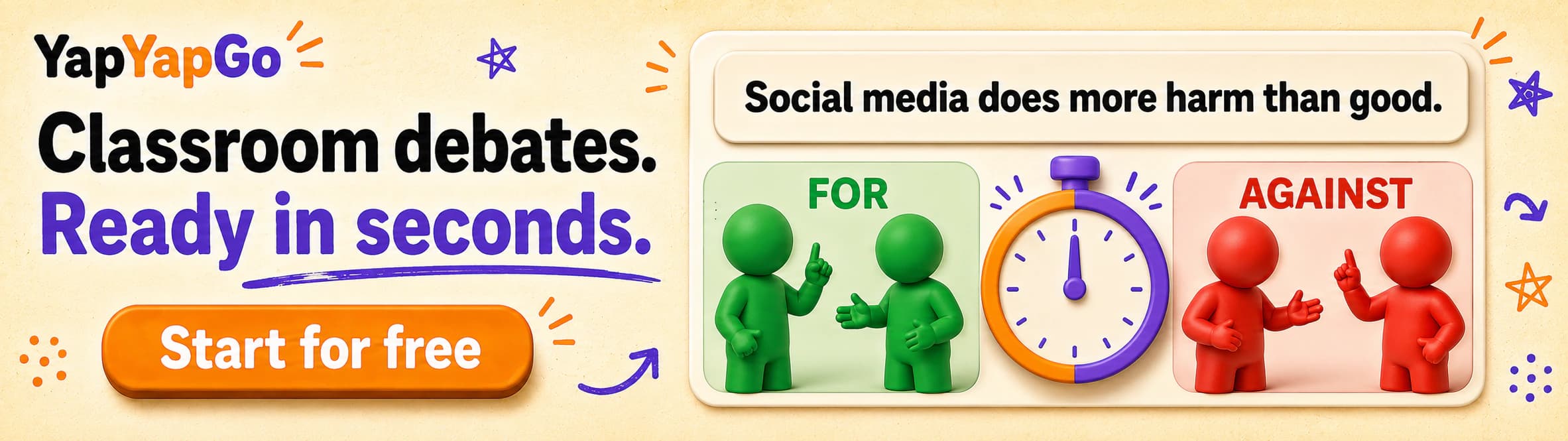
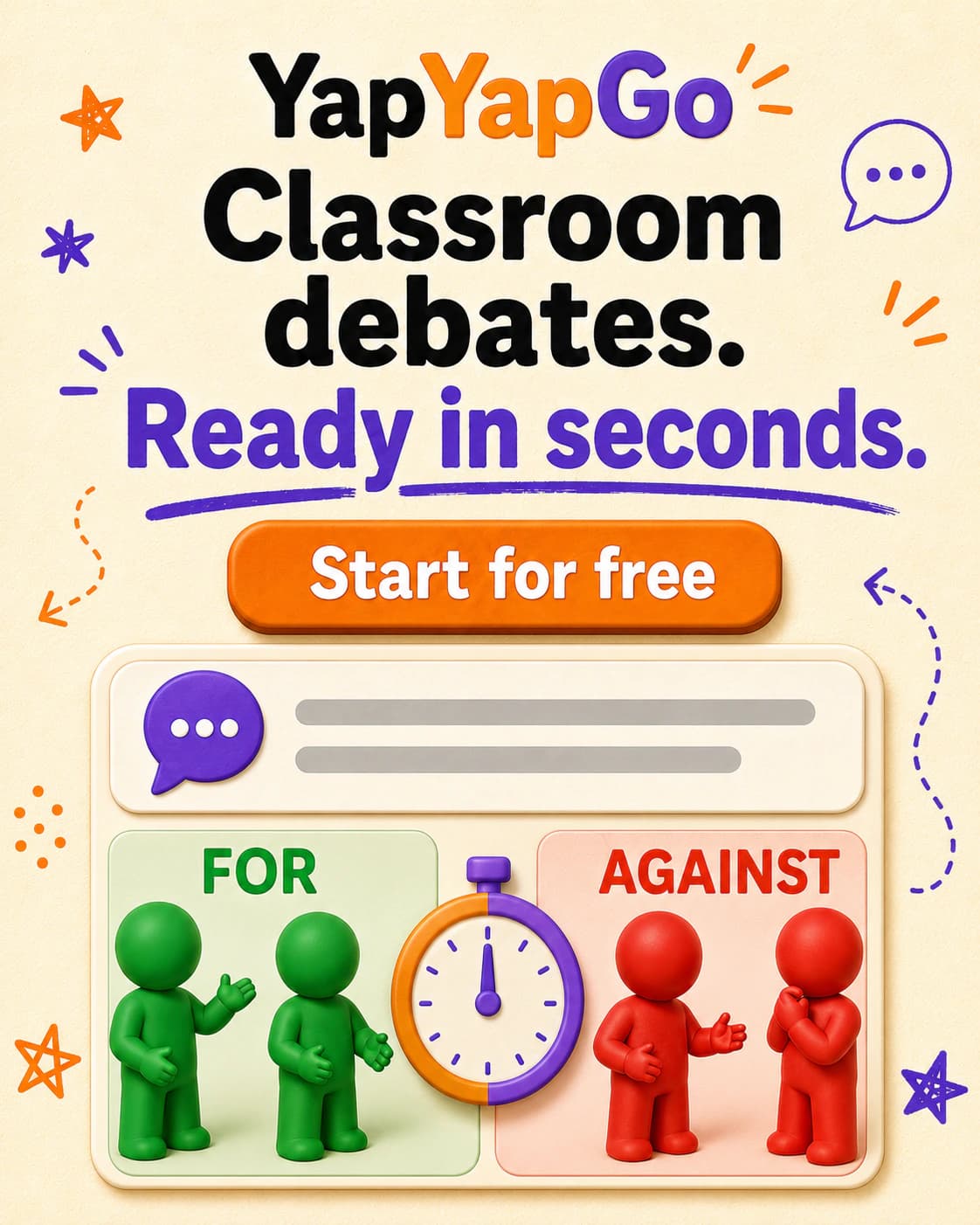
YapYapGo is a classroom speaking practice tool for ESL and EFL teachers with a Debate mode that handles the timing automatically. The standalone debate timer is free and runs two-sided for/against timing with speech and prep phases. Here's exactly how timed debate works and why the timer is the most important element.What the timer does to speaking
It equalises participation. In an untimed debate, the student with more language confidence speaks more. The timer prevents this completely. Both students get the same speaking time, regardless of confidence or language level. It creates productive pressure. When students can see 30 seconds remaining, they prioritise. They make their strongest point now rather than building up to it. They get to their example rather than circling around it. The visible clock trains the habit of front-loading the strongest material - exactly what IELTS examiners look for and what professional communication requires. It prevents mid-speech collapse. Students who run out of things to say during a timed activity are more likely to keep going than students in an open format. The visible clock makes stopping feel like a failure. This psychological pressure is what drives the production of additional, more complex language. It signals when to stop. In untimed debates, transitions are awkward. When is the other person done? When do I start? The timer removes all of this. When it hits zero, the speaking phase ends. Clean, predictable, no social negotiation required.The debate timer format
A complete timed pair debate runs in five phases:
Phase 1: Preparation (2 minutes) Students are given a statement and their assigned position (for or against). They have two minutes of silent preparation. Key words only - not a written speech. This phase significantly improves the quality of the debate by allowing students to think before they speak rather than thinking while they speak. Phase 2: Opening arguments (90 seconds each) Student A presents their position for 90 seconds, uninterrupted. Then Student B. Neither can respond to the other during this phase. The uninterrupted format forces each student to construct a complete argument rather than reacting. Phase 3: Free discussion (2-3 minutes) Both students respond to what they heard. This is where the debate becomes genuinely interesting - students have heard each other's strongest arguments and can now challenge, concede, or build on them. Phase 4: Closing statements (30 seconds each) Each student has 30 seconds to make their final point. The short time limit forces distillation - students must identify their single strongest argument and state it clearly. Phase 5: Position change (optional) Ask students to share whether they've changed their view based on what they heard, and why.Total time: approximately 10-12 minutes per topic.
The visible timer makes the difference
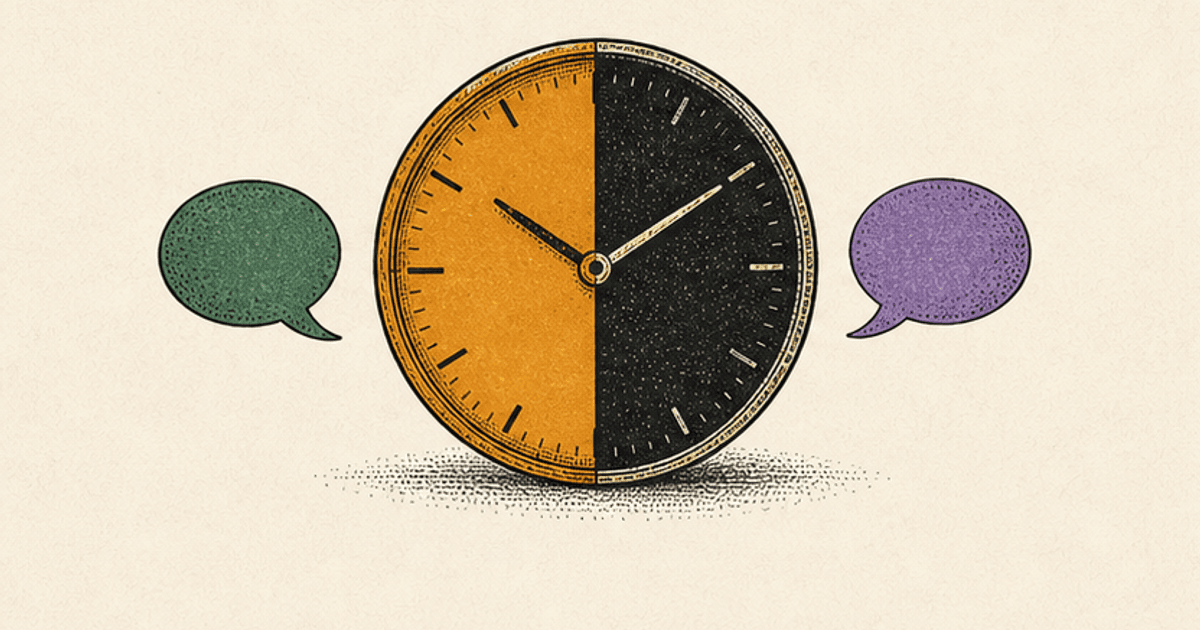
An audible timer that only beeps at the end is significantly less effective than a visible countdown that students can see throughout. Here's why:
When students can see 60 seconds remaining, they begin to prioritise. They skip their weaker point and lead with their strongest. When they can see 20 seconds remaining, they know to start their closing statement. When they can see 10 seconds remaining, they know to land their final word.
This pacing awareness is exactly what the IELTS Part 2 examiner is looking for, what a job interviewer appreciates, and what makes professional presentations effective. The visible timer teaches it directly.
Tool tip: YapYapGo's Debate mode displays a visible two-sided countdown for both speaking phases. It automatically transitions between prep, speaking, and discussion phases so you never have to call time manually. The standalone debate timer does the same if you want to run your own topics rather than YapYapGo's question bank. Either way, both students can see the clock throughout their speaking turn.
Choosing the right time limits
Time limits need to match your students' level:
A2-B1: 60 seconds for opening arguments. A2 students who are asked to speak for 90 seconds will often fill the time with repetition rather than new content. 60 seconds forces compression and prioritisation without overwhelming. B1-B2: 90 seconds for opening arguments. This is the sweet spot for most ESL students - long enough to make a complete argument with a reason and an example, short enough to maintain focus. B2-C1: 2 minutes for opening arguments. Advanced students can sustain longer arguments and benefit from the additional time to develop complex reasoning. Closing statements: Always 30 seconds at every level. The compression challenge of a 30-second closing is itself a valuable speaking skill.Adapting for large classes
The pair debate format scales perfectly to large classes because every student debates simultaneously. While 15 pairs debate, you circulate and observe. No one waits for a turn.
After two or three rounds, ask one pair per round to replay their strongest exchange for the class. A random student picker keeps this selection fair and prevents the same confident students from volunteering every time.
Topics that work best with a timer
Timed debate works best with topics that have genuinely defensible positions on both sides. If one position is obviously stronger, students assigned the weaker side run out of material before the timer ends.
For adult learners: workplace policy debates, technology and society, environmental trade-offs. For teenagers: school life, social media, entertainment. For IELTS preparation: any IELTS Part 3 abstract question reformulated as a debate statement.
For 80 adult debate topics organised by level, see our post on debate topics for adult ESL learners. For the full guide to running classroom debates, see how to run a classroom debate with ESL students.
Sources:
- Nation, I.S.P. (1989). Improving Speaking Fluency. System. - Time pressure drives automatisation and fluency development.
- Skehan, P. (1998). A Cognitive Approach to Language Learning. Oxford University Press. - Time constraints affect fluency, accuracy, and complexity trade-offs.
- Thai, C. & Boers, F. (2016). Repeating a Monologue Under Increasing Time Pressure. TESOL Quarterly. - Visible time pressure produces better language organisation than invisible time limits.