← All posts
25 Zero-Prep ESL Speaking Activities You Can Use Tomorrow

25 Zero-Prep ESL Speaking Activities You Can Use Tomorrow

It's 7:45am. Your first class starts in fifteen minutes. You haven't prepped a thing.

We've all been there. Maybe the weekend disappeared. Maybe your last lesson ran long and you never got around to planning the next one. Maybe you're covering someone else's class with five minutes' notice.

Here's the thing: speaking practice doesn't need a stack of worksheets. Some of the most effective speaking activities in language teaching require absolutely nothing except students and a question. That's not a shortcut — it's actually how speaking fluency develops best: through regular, low-pressure, conversation-based practice with a partner.

YapYapGo was built around this exact principle — a zero-prep classroom speaking practice tool with thousands of levelled questions, automatic student pairing, and built-in timers. But whether you use a tool or just your voice, these 25 activities will fill any lesson with real speaking practice.

Pair-based activities (the foundation)

The single most effective change you can make to any speaking lesson is switching from whole-class Q&A to pair work. When 30 students work in 15 pairs simultaneously, individual speaking time jumps from roughly 30 seconds to 7+ minutes per student. That's not a small improvement — it's a fourteen-fold increase.

1. Question tennis. Display or read out a discussion question. Pairs take turns answering, but each answer must be at least three sentences long. When one person finishes, the other responds or adds to it. Simple, endlessly adaptable. 2. Two-minute talk. One student talks about a topic for two minutes straight while their partner listens. Then swap. Use a visible timer — the time pressure builds fluency. This is essentially the 4/3/2 technique used in fluency research, and it works because repeated production under time constraints forces students to speak more efficiently. 3. Opinion swap. Read out a statement ("Social media does more harm than good"). Student A argues for, Student B argues against — regardless of their actual opinion. After two minutes, they swap sides. This builds the ability to articulate different viewpoints, which is a key skill in IELTS Part 3 and Cambridge speaking exams. 4. Three things in common. Pairs have three minutes to find three things they have in common that aren't obvious (not "we're both in this class"). Forces genuine information exchange and follow-up questions. 5. Would you rather. Read two options: "Would you rather live in the mountains or by the sea?" Each student picks one and explains why. Then their partner asks a follow-up question. Easy to level up by making the choices more abstract for higher levels.
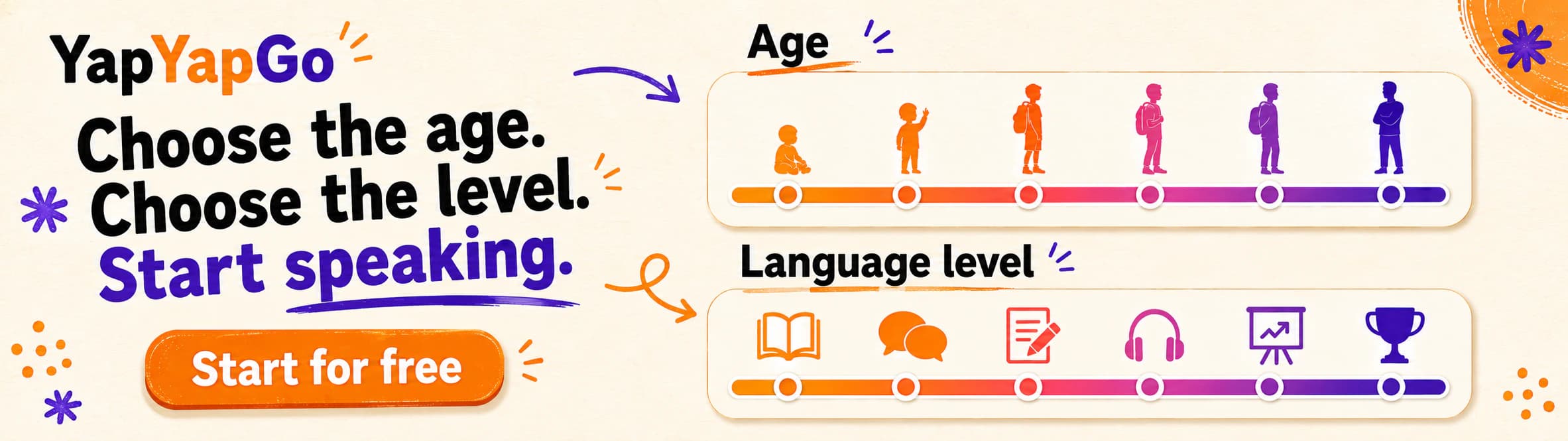
Tool tip: YapYapGo has a dedicated Free Conversation mode with thousands of questions sorted by age group and CEFR level (A2–C1). Open it, hit shuffle, and the question appears on screen for the whole class. Zero prep, zero photocopies.
6. Finish the sentence. Give a sentence starter: "The worst thing about learning English is..." or "If I could change one thing about my country..." Partner A completes it, Partner B asks follow-up questions. 7. Describe and guess. Student A thinks of a person, place, or thing. Student B asks yes/no questions to guess it. Maximum 20 questions. Good for all levels and naturally generates question forms. 8. Good news, bad news. Give a scenario: "You've won a free holiday, but..." Student A gives the good news version, Student B gives the bad news version. Alternating perspectives keeps it lively. 9. Memory challenge. Student A describes their morning routine in detail. Student B listens, then tries to repeat it back from memory. Then swap. Practices past tenses and sequencing naturally. 10. One word story. Pairs build a story one sentence at a time, alternating. Each sentence must connect logically to the last. Sounds silly, but it forces creative, spontaneous production — which is exactly what fluency training is about.

Timed and structured activities

Adding a timer transforms any speaking activity. Research on fluency development shows that time pressure — even gentle time pressure — pushes students to produce language more automatically, which is the hallmark of fluency.

11. 60-second expert. Give a random topic (bananas, the colour blue, shoes). The student has to talk about it for 60 seconds as if they're a world expert. The partner counts hesitations. Absurd topics work best — they remove the pressure of needing "real" knowledge. 12. Speed round. Display five questions. Pairs race to discuss all five in three minutes. When the timer ends, they count how many they got through. Competitive element adds energy. 13. The countdown challenge. Student A talks about a topic for two minutes, then one minute, then 30 seconds. Each time they have to cover the same key points but faster. This is a simplified version of Nation's 4/3/2 fluency technique, and the research shows it produces measurable fluency gains.
Tool tip: YapYapGo's Timed Talk mode does exactly this — it displays a question with a countdown timer so the whole class practises under the same time pressure simultaneously. The teacher doesn't have to manage anything.
14. Debate in a minute. Read a motion: "This house believes homework should be abolished." Each student gets one minute to argue their assigned side. Short, punchy, and it stops students from overthinking. 15. Hot seat. One student sits with their back to the board. Their partner describes the word/concept on the board without saying it. One minute on the clock. Then swap.

Whole-class activities (low prep, high energy)

These work well as warm-ups or fillers. They're slightly louder and more chaotic than pair work, but the energy is worth it.

16. Stand up, sit down. Read a statement: "I've been to more than three countries." Everyone who agrees stands up. Pick two standing students to elaborate. Pick two sitting students to explain why not. Quick, inclusive, and it gets bodies moving. 17. Mingle and report. Everyone walks around the room. When you clap, they pair with whoever is nearest and discuss a question for 90 seconds. Clap again, they switch. After three rounds, ask individuals to report what their last partner said (not what they said themselves — this forces listening). 18. Alibi. Two students leave the room. They have two minutes to create a shared alibi for where they were last night. The class interrogates them separately to find inconsistencies. Requires no materials and generates enormous amounts of engaged speaking. 19. Class survey. Give a question: "What's the best age to get married?" Everyone asks three different classmates and notes their answers. Then discuss the results as a class. The pair conversations are where the real speaking practice happens. 20. Just a minute. One student tries to talk about a given topic for exactly one minute without hesitation, repetition, or deviation. Others listen and challenge. Based on the BBC radio show — works brilliantly with B2+ students.

Question-driven conversation activities

The simplest, most repeatable format: give students a good question and let them talk. The quality of the question matters enormously — vague prompts ("discuss technology") produce vague conversations, while specific questions ("Would you trust a robot to perform surgery on you?") produce genuine debate.

21. Question chain. Student A answers a question. Then Student A asks Student B a related but different question. Student B answers and asks Student C, and so on around the room. Forces spontaneous question formation. 22. Topic deep dive. Give pairs a broad topic (food, travel, education). They have five minutes to go as deep as they can — from surface observations to personal opinions to abstract questions. The goal is to move beyond small talk. 23. Agree to disagree. Pairs are given a controversial statement. They discuss it, but the goal is to find the specific point where they disagree — and articulate it clearly to the class. Teaches precision in expressing opinions. 24. Past, present, future. Give a topic. Student A talks about it in the past ("When I was young, technology was..."), Student B in the present, then they both speculate about the future. Naturally practises different tense systems. 25. The interview. One student is a famous person (real or fictional). The other interviews them. Five minutes, then swap roles. Good for practising question forms and extended answers.
Tool tip: YapYapGo offers six different speaking modes — Free Conversation, Timed Talk, Topic Discussion, Debate, IELTS Speaking, and AI-generated questions — all with automatic pair shuffling and age/level matching. It's free to start, and you can get your first session running in about 60 seconds. If zero-prep speaking practice is a regular need, it's worth a look.

Why zero-prep works

There's a common assumption that more preparation equals better lessons. For grammar instruction, that might be true. But for speaking practice, the opposite is often the case.

The research on fluency development consistently shows that what matters most is volume of practice — how many minutes each student actually spends producing spoken language. A perfectly planned speaking activity that only three students get to do is less effective than a simple question that all 30 students discuss in pairs for five minutes.

Your job during speaking activities isn't to deliver content. It's to circulate, listen, note patterns, and give feedback after the activity — not during it. That's where your expertise adds the most value. The activity itself just needs to be a clear prompt that gives students a reason to talk.


Sources:
  • Nation, I.S.P. (1989). Improving Speaking Fluency. System. — The 4/3/2 technique and the case for fluency through repetition.
  • Long, M. & Porter, P. (1985). Group Work, Interlanguage Talk, and Second Language Acquisition. TESOL Quarterly. — Pair work increases individual speaking time by 14x.
  • De Jong, N. & Perfetti, C. (2011). Fluency Training in the ESL Classroom. Language Learning. — Time-pressured repeated practice produces lasting fluency gains.
  • Swain, M. (1985). Communicative Competence: Some Roles of Comprehensible Input and Comprehensible Output. In Input in Second Language Acquisition. — The Output Hypothesis: speaking drives acquisition.

Ready to try it in your classroom?

YapYapGo is free to start — no account needed. Set up your first speaking session in under a minute.

Start for free →