You have a conversation class in twenty minutes and you haven't prepared anything.
This isn't a disaster. It's actually an opportunity — because the best conversation classes don't need a stack of materials. They need a clear structure, good questions, and enough time for every student to actually speak.
Here's a complete 45–60 minute lesson format you can use today, next week, or any time you need a reliable speaking lesson that requires zero preparation.
The format: three rounds, three modes
This structure works because it gives students variety without requiring you to prepare three different activities. Each round uses a different speaking format, which keeps energy high and targets different skills.
Round 1: Warm-up conversation (10 minutes)Pair students up. Display or read a simple, open question — something personal and accessible. "What's the best meal you've had this week?" or "What did you do last weekend that you'd recommend?" Give pairs three minutes to discuss, then shuffle partners and give a second question.
The goal here isn't deep discussion — it's getting voices warmed up. Students who've been sitting in silence all morning need a low-stakes entry point before you ask them to do anything challenging.
Round 2: Structured discussion (15–20 minutes)This is the core of the lesson. New pairs. A meatier question that requires opinions and reasoning: "Should schools ban mobile phones?" or "Is it better to rent or buy a home?"
Give students one minute of thinking time before they start — research shows that even 60 seconds of planning significantly improves fluency and reduces anxiety. Then let them discuss for five minutes. When energy dips, call time, shuffle pairs, and give a new question.
Two or three questions in this round is plenty. The rotation is what keeps it fresh — new partner, new conversation, new challenge.
Round 3: Timed challenge (10 minutes)Final round. New pairs again. This time, add a timer. One student talks about a topic for exactly two minutes while their partner listens. Then swap. The time pressure is the point — it pushes students toward more automatic, fluent production.
Topics can be simple: "Talk about a place you love," "Describe your ideal weekend," "Explain why you're learning English." The constraint forces extended speech, which is exactly what builds fluency.
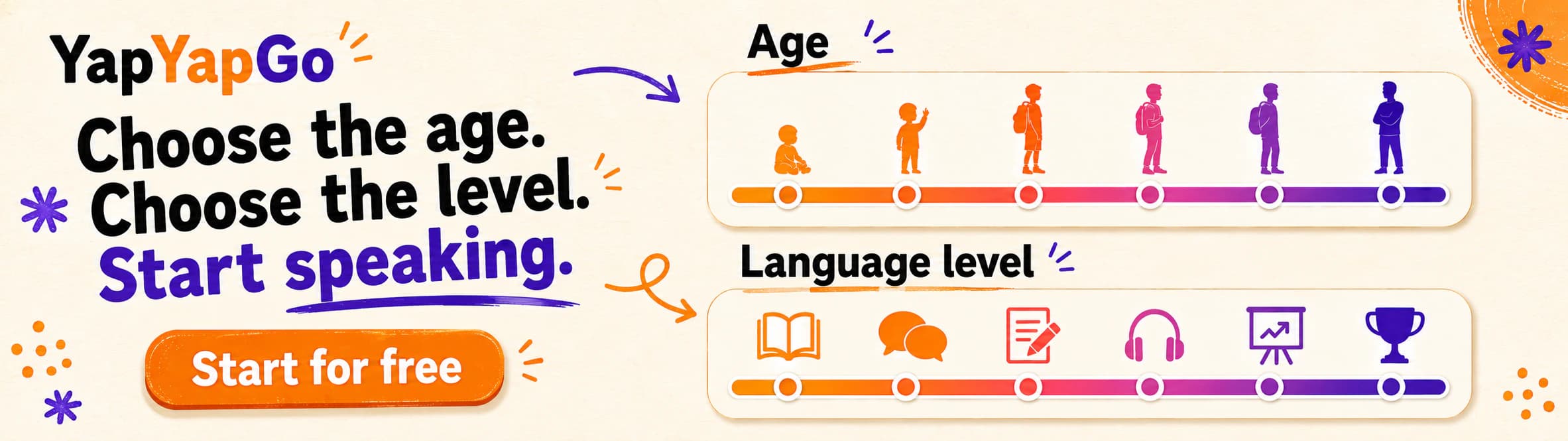
Tool tip: YapYapGo is a free classroom speaking practice tool designed for exactly this format. It has six speaking modes — including Free Conversation, Timed Talk, and Topic Discussion — with thousands of age- and level-appropriate questions, automatic pair shuffling, and built-in timers. You can run this entire lesson structure without preparing a single thing.
The last five minutes: debrief
Save the final five to ten minutes for whole-class feedback. This is where your expertise matters most.
While students were talking, you were circulating and listening. You've noticed patterns — maybe several pairs struggled with conditional structures, or nobody could express disagreement politely. Address two or three points as a class. Write example sentences on the board. Ask students to rephrase.
This debrief is more effective than correcting errors during the activity. Students have something concrete to reflect on because they've just been speaking, and you're addressing patterns rather than singling out individuals.

Why this works every time
This format succeeds for a few reasons:
It maximises speaking time. In 45 minutes, each student gets roughly 15–20 minutes of actual speaking time. Compare that to the 30 seconds they'd get in a teacher-led Q&A format. It's infinitely repeatable. The structure stays the same — only the questions change. You could use this format three times a week for an entire term and it wouldn't get stale, because the questions and partners rotate constantly. It builds fluency through variety. Each round targets a different skill: casual conversation, structured argumentation, and extended monologue under time pressure. That variety is important — fluency isn't one skill, it's a cluster of skills that develop through different types of practice. It removes your workload. No photocopies, no cutting up cards, no preparing role play scenarios. Your energy goes where it's most valuable: listening to students speak and giving targeted feedback.Scaling the questions
The one thing this format does need is good questions. Bad questions ("Discuss technology") produce dead-air conversations. Good questions ("If you could uninvent one technology, what would it be and why?") produce genuine exchanges.
The key qualities of a good speaking question: it's specific enough to give students a foothold, open enough that there's no single "right" answer, and pitched at the right level so students can respond without needing vocabulary they don't have.
Building a personal bank of reliable questions takes time. Or you can use YapYapGo, which maintains a bank of thousands of questions across ten topic categories, matched to age group (teens, young adults, adults) and CEFR level (A2 to C1). The question bank tracks what each class has already seen, so you never accidentally repeat a question. It's the zero-prep part of zero-prep conversation classes.
Adapting for different levels
A2 Elementary: Keep Round 1 questions very concrete and personal. Round 2 can use "Would you rather..." format instead of open discussion. Round 3 works as a 60-second talk instead of two minutes. B1 Intermediate: The format as described works perfectly at this level. Questions should be specific but not too abstract. B2+ Upper-Intermediate and above: Push Round 2 toward debate territory — give students a position to defend rather than just discuss. Round 3 can include follow-up questions from the listening partner.Try it
If you want to run this format with no planning at all — questions, pairing, and timers all handled for you — YapYapGo was built for exactly this. It's free to start, and it takes about 60 seconds to launch your first session. Your students will be talking before you've finished your coffee.
Sources:
- Foster, P. & Skehan, P. (1996). The Influence of Planning and Task Type on Second Language Performance. Studies in Second Language Acquisition. — Planning time improves fluency.
- Nation, I.S.P. (1989). Improving Speaking Fluency. System. — Timed, repeated speaking practice builds fluency.
- Long, M. & Porter, P. (1985). Group Work, Interlanguage Talk, and Second Language Acquisition. TESOL Quarterly. — Pair work increases speaking time by 14x over whole-class formats.
- Sato, M. & Lyster, R. (2012). Peer Interaction and Corrective Feedback. Studies in Second Language Acquisition. — Peer practice increases both fluency and accuracy.