Why mixed levels aren't the disaster they seem
The instinct is to see mixed levels as a problem to solve. But research on peer interaction suggests it can actually be an advantage - if you manage it right.
When a stronger speaker works with a weaker one, the stronger student simplifies their language, provides models, and scaffolds the conversation. The weaker student hears more complex language in a low-pressure context and gets pushed to produce more than they would alone. This is essentially what the research calls "negotiation of meaning" - and it's one of the most powerful drivers of language acquisition.
The catch: this only works when both students are actively participating. If the stronger student dominates and the weaker student goes passive, nobody benefits. The activity structure has to ensure both people contribute equally.
Seven activity types that work across levels
1. Open-ended discussion questions
The simplest and most effective approach. A good discussion question works at every level because students respond at their own level of complexity.
"Would you rather live in a big city or a small town?" A2 students answer with simple preferences and basic reasons. B2 students weigh trade-offs and consider abstract factors. Same question, different depth - and both students are speaking.
The question does the differentiation for you. No need to prepare separate materials.
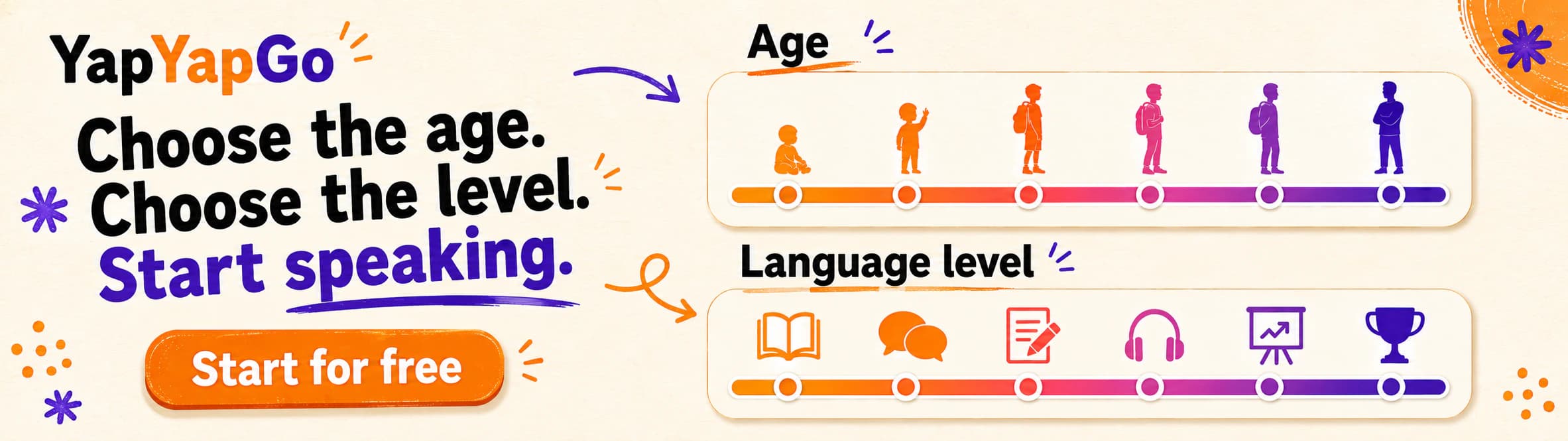
Tool tip: YapYapGo is a free classroom speaking practice tool with questions across CEFR levels A2 to C1. In a mixed-level class, you can set the level to match your middle band - the questions are open-ended enough that lower students can respond simply and higher students can go deep. Automatic pair shuffling means everyone works with different partners.
2. Opinion spectrums
Read a statement: "Money is more important than free time." Students tell their partner whether they strongly agree, agree, disagree, or strongly disagree - and explain why.
This format naturally differentiates. A2 students give a position and one reason. B2 students give nuanced conditional responses. The task is the same; the language output scales with ability.
3. Information exchange tasks
Pair activities where Student A has information Student B needs and vice versa. These work across levels because both students must communicate to complete the task - passive listening isn't an option.
Example: "Student A, describe your perfect holiday. Student B, listen and then tell A what your perfect holiday would be. Then together, plan a compromise holiday you'd both enjoy."
The compromise stage forces genuine negotiation regardless of level.
4. Timed fluency challenges
Give the same topic to everyone. Each student speaks for two minutes. The language that comes out will naturally vary by level - that's fine. The exercise targets fluency (speaking at speed without excessive pausing), which is a skill every level needs to develop.
YapYapGo's Timed Talk mode runs a
countdown timer visible to the whole class. Every pair practises simultaneously under the same time pressure, regardless of their individual levels.
5. Role plays with flexible roles
Give a scenario where one role naturally requires simpler language: "Student A is a tourist asking for directions. Student B is a local giving directions." The tourist can use simple questions; the local needs more complex language.
Flexible role assignment lets you informally differentiate without making it obvious. Lower-level students get the role that requires simpler output; higher-level students get the role that pushes them.
6. Debate with scaffolded positions
Debates work across levels when you scaffold the lower-level position. Give both students a motion, but give the weaker student a list of three argument starters: "I think... because..." "One reason is..." "For example..."
The stronger student argues freely. The weaker student has a framework to build on. Both students are debating - the scaffolding just ensures the weaker student can participate meaningfully.
7. Discussion question chains
Start with a concrete question, then follow with progressively more abstract ones on the same topic. "Do you like cooking?" → "Should everyone learn to cook?" → "How does food connect to cultural identity?"
Pairs work through as many questions as they can. Lower-level pairs might spend all their time on the first two. Higher-level pairs push through to the abstract ones. Same activity, self-differentiating pace.