B1 Debate Motions for Late Teens (16-18)
75 debate motions for B1 level teenagers (16-18). Age-appropriate topics designed for classroom debates. Preview 5, use all 75 in YapYapGo.

BasicB1 Intermediate
Motion 1
School uniforms should be required in all schools
Use in YapYapGo with colour-coded teams and speech timer
Motion 2
Students should choose their own subjects in high school
Use in YapYapGo with colour-coded teams and speech timer
Motion 3
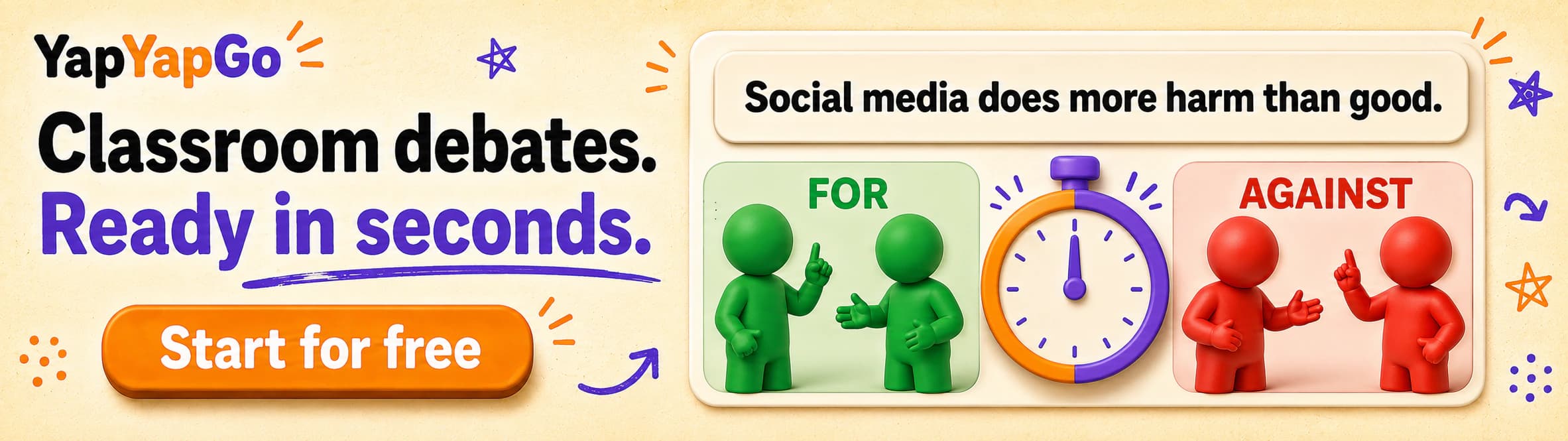
Social media does more harm than good for teenagers
Use in YapYapGo with colour-coded teams and speech timer
Motion 4
Part-time jobs are important for high school students
Use in YapYapGo with colour-coded teams and speech timer
Motion 5
Online learning is better than classroom learning
Use in YapYapGo with colour-coded teams and speech timer
Motion
This statement is gated behind the preview...
Motion
This statement is gated behind the preview...
Motion
This statement is gated behind the preview...
Motion
This statement is gated behind the preview...
🔒

70 more debate motions

Use all 75 debate motions at B1 level in YapYapGo's Debate mode. Teams are colour-coded, speech timers are built in, and motions never repeat.

Colour-coded teamsSpeech timerNo repeatsCustom motions
Try Debate Mode
Part of YapYapGo Basic. From $3/month.

Built for teachers who run speaking lessons every day

YapYapGo handles the logistics: student pairing, question delivery, timers, and session tracking. You focus on facilitation and feedback.

See Plans

Explore More Questions

Other Age Groups

B1 Debate Motions for Late Teens (16-18)
Teenage classrooms come alive during debates in a way they rarely do during other activities. The competitive element, the team dynamics, and the permission to argue all tap into what 16-18 year olds are naturally drawn to. These 75 motions are written for B1 teens, covering school life, social media, fairness, youth culture, and personal freedom. Motions like 'Students should choose their own subjects from age 14' and 'Social media does more harm than good for teenagers' hit topics where every student has a position to defend.

The motions use simple, direct language that B1 teens can understand immediately. There is no formal debate jargon and no complex conditional structures. This means students can focus entirely on thinking up arguments and finding the English to express them, rather than deciphering what they are supposed to be debating.

Why teens love debate more than discussion

Discussion asks students to share opinions politely. Debate gives them permission to disagree, challenge, and persuade. For many teens, this permission is what unlocks their willingness to speak in English. The team structure also helps: students who would never volunteer an opinion individually will argue passionately when they feel accountable to a team.

Managing energy in teen debates

Teen debates can get loud and unfocused without structure. Use short speech times (60-90 seconds), enforce a preparation period, and require that speakers address a specific point from the other side. In YapYapGo, the speech timer and round tracker keep the activity moving. Colour-coded teams (green for and red against) make it visually clear who is speaking next.

Frequently Asked Questions

Yes. All motions are classroom-safe and avoid sensitive political, religious, or personal topics. They focus on school life, technology, social media, youth culture, and fairness, all areas where teens have strong but non-controversial opinions.
Teen motions focus on issues relevant to 16-18 year olds: school rules, social media, peer pressure, and independence. Adult motions tend toward workplace issues, financial ethics, and social policy. The language level is the same, but the content reflects different life experiences.
Debate practice develops the argumentation and discourse skills tested in Cambridge PET and IELTS. While exams do not use a debate format directly, the ability to construct and defend an argument transfers directly to exam speaking tasks.