B2 Debate Motions for Young Learners (7-9)
75 upper-intermediate (B2) debate motions for 7-9 year olds. Challenging topics for strong young debaters. Preview 5, use all 75.

BasicB2 Upper-Intermediate
Motion 1
Children should be allowed to choose their own bedtime
Use in YapYapGo with colour-coded teams and speech timer
Motion 2
Homework should be banned on weekends
Use in YapYapGo with colour-coded teams and speech timer
Motion 3
All schools should have uniforms
Use in YapYapGo with colour-coded teams and speech timer
Motion 4
Children should get paid for doing chores
Use in YapYapGo with colour-coded teams and speech timer
Motion 5
Video games are better than board games
Use in YapYapGo with colour-coded teams and speech timer
Motion
This statement is gated behind the preview...
Motion
This statement is gated behind the preview...
Motion
This statement is gated behind the preview...
Motion
This statement is gated behind the preview...
🔒

70 more debate motions

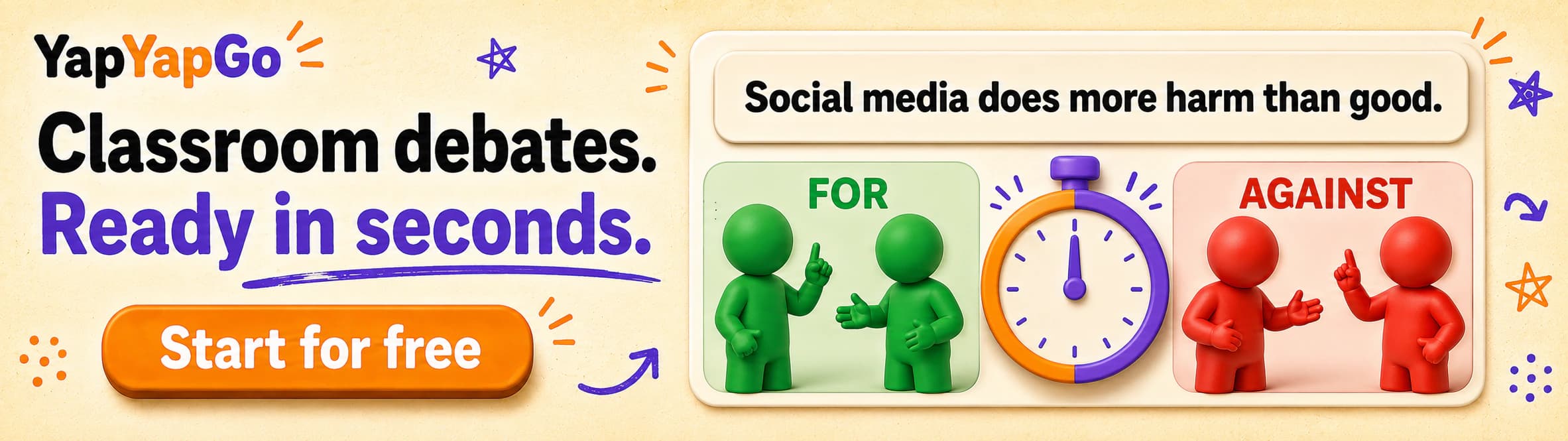
Use all 75 debate motions at B2 level in YapYapGo's Debate mode. Teams are colour-coded, speech timers are built in, and motions never repeat.

Colour-coded teamsSpeech timerNo repeatsCustom motions
Try Debate Mode
Part of YapYapGo Basic. From $3/month.

Built for teachers who run speaking lessons every day

YapYapGo handles the logistics: student pairing, question delivery, timers, and session tracking. You focus on facilitation and feedback.

See Plans

Explore More Questions

Other Age Groups

B2 Debate Motions for Young Learners (7-9)
B2 young learners are near-native speakers who benefit from debate as a thinking exercise rather than a language exercise. These 75 motions present ethical and practical dilemmas scaled to a child's world: 'It is wrong to keep fish in small bowls,' 'Children should help decide school rules,' 'It is better to read books than watch films.' These motions have no obvious right answer, which forces children to reason and justify rather than simply assert.

At B2, the language is not the challenge but the reasoning is. Children must learn to construct arguments with supporting logic, consider why someone might disagree, and respond to challenges. These are cognitive skills that debate develops uniquely well.

Reasoning and debate for near-native children

Extend to 45 seconds per speaker and introduce a simple rebuttal: 'Tell the other team why their best reason is wrong.' This is cognitively demanding for 7-9 year olds but B2 speakers have the language to handle it. The rebuttal teaches children that good arguments address opposing views.

Thinking skills through argumentation

These motions work well in gifted programmes, international school enrichment, and bilingual education contexts. The debate format provides the intellectual challenge that near-native young learners crave but rarely find in standard English materials.

Frequently Asked Questions

Near-native speakers: bilingual children, international school students, or children who have lived in English-speaking countries. The language is not the challenge; the reasoning is.
Yes. All motions focus on children's experiences: animals, school, fairness, reading, and everyday ethics. Nothing is adult-oriented or potentially distressing.
Yes. These motions are ideal for primary school debate clubs where near-native speakers need structured argumentation practice with age-appropriate topics.