B1 Debate Motions for Early Teens (13-15)
75 intermediate (B1) debate motions for 13-15 year olds. Engaging topics for classroom debates. Preview 5, use all 75 in YapYapGo.

BasicB1 Intermediate
Motion 1
School uniforms should be mandatory.
Use in YapYapGo with colour-coded teams and speech timer
Motion 2
Homework should be banned on weekends.
Use in YapYapGo with colour-coded teams and speech timer
Motion 3
Students should choose their own subjects at school.
Use in YapYapGo with colour-coded teams and speech timer
Motion 4
Mobile phones should be allowed in classrooms.
Use in YapYapGo with colour-coded teams and speech timer
Motion 5
Fast food should be banned in school cafeterias.
Use in YapYapGo with colour-coded teams and speech timer
Motion
This statement is gated behind the preview...
Motion
This statement is gated behind the preview...
Motion
This statement is gated behind the preview...
Motion
This statement is gated behind the preview...
🔒

71 more debate motions

Use all 76 debate motions at B1 level in YapYapGo's Debate mode. Teams are colour-coded, speech timers are built in, and motions never repeat.

Colour-coded teamsSpeech timerNo repeatsCustom motions
Try Debate Mode
Part of YapYapGo Basic. From $3/month.

Built for teachers who run speaking lessons every day

YapYapGo handles the logistics: student pairing, question delivery, timers, and session tracking. You focus on facilitation and feedback.

See Plans

Explore More Questions

Other Age Groups

B1 Debate Motions for Early Teens (13-15)
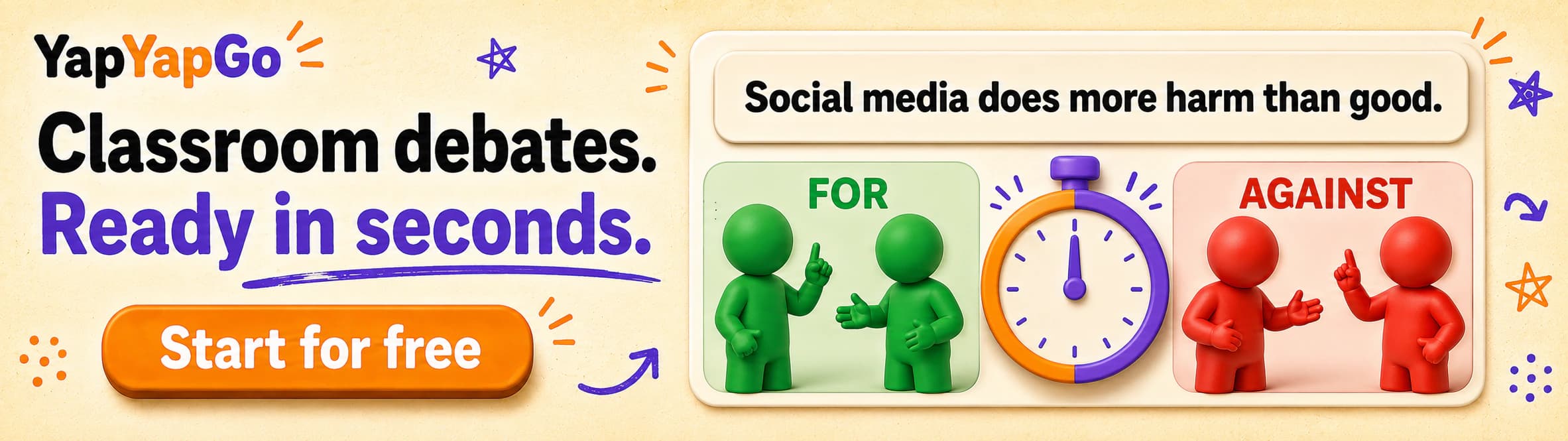
B1 early teens can do more than state opinions. They can give reasons, compare options, and respond to counter-arguments with support. These 75 motions step up the complexity from A2 by introducing topics where the answer is genuinely unclear: 'Homework helps students learn,' 'It is better to be popular than to be smart,' 'Schools should teach cooking instead of art.' These motions generate real disagreement because reasonable people genuinely disagree about them.

At B1, the debate format starts developing genuine argumentation skills. Students learn to say 'I understand that some people think... but I disagree because...' which is a concession-and-counter structure that marks the transition from elementary to intermediate discourse. Debate practice at B1 accelerates this development because the competitive format makes students reach for more sophisticated language to outperform their opponents.

Building real arguments at B1

Extend speeches to 60 seconds and give teams 2-3 minutes to prepare. At B1, students can sustain a short argument with a claim, a reason, and an example. Require all team members to speak so that confident students cannot dominate. In YapYapGo, the timer and round tracking keep the activity structured and fair.

The competitive advantage of debate

B1 early teens respond strongly to debates where they feel the topic is unfair in some way. Motions about school rules, screen time limits, and pocket money generate the most passionate responses because students feel personally affected. This emotional engagement produces more language output than any textbook exercise.

Frequently Asked Questions

60 seconds per speaker. This is enough time for a claim, a reason, and an example. Give teams 2-3 minutes of preparation time before each round.
No. Assigning sides randomly (which YapYapGo does automatically) is more valuable because it forces students to argue positions they may not agree with. This develops flexibility and perspective-taking.
The motions are deliberately accessible so that the challenge comes from building arguments, not understanding the topic. If students find the argumentation too easy, try B2 level motions which introduce more abstract concepts.