B2 Debate Motions for Pre-Teens (10-12)

Watch a tutorial on how to run this activity with your class
Explore More Questions
B2 Debate Motions for Pre-Teens (10-12)
B2 pre-teens are capable of genuine analytical debate. These 75 motions challenge gifted 10-12 year olds to examine assumptions and weigh consequences: 'Animals should not be used in scientific experiments,' 'Everyone should learn to code,' 'Rich countries have a responsibility to help poor countries.' These are questions without easy answers, which forces students to build arguments from reasoning rather than gut feeling.
At B2, the language of debate becomes as important as the ideas. Students can practise discourse patterns like 'On the one hand... on the other hand...,' 'While it is true that...,' and 'This leads to the conclusion that...' These structures are the scaffolding of academic English that B2 pre-teens will need as they move into secondary school.
Critical thinking through debate
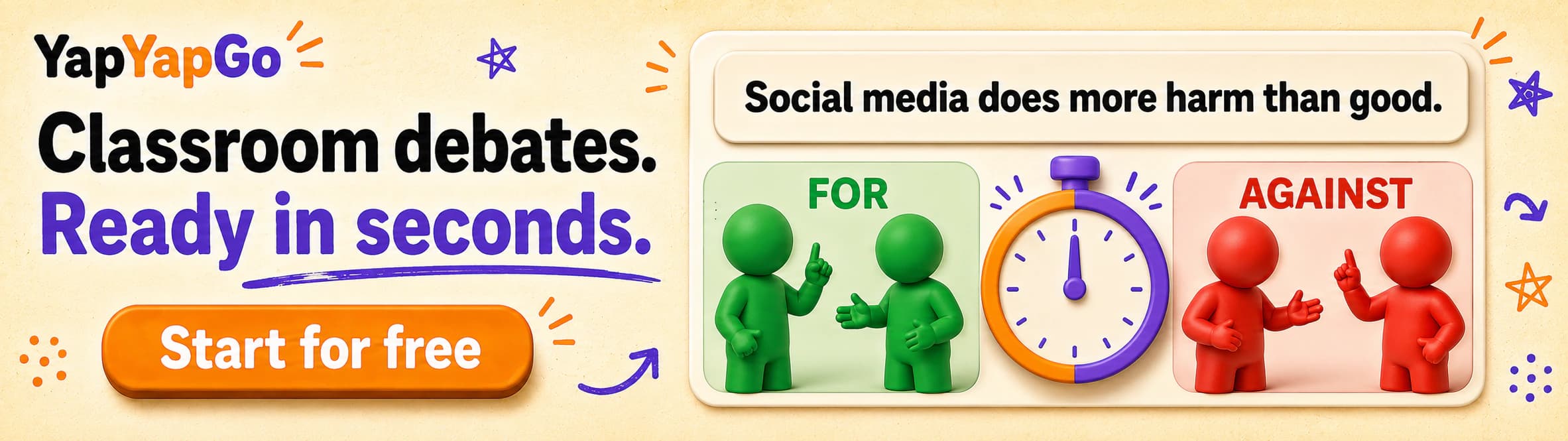
Extend speeches to 60-90 seconds and add a short rebuttal round (30 seconds). The rebuttal teaches B2 pre-teens to listen carefully and respond to specific points, not just repeat their own arguments. This is a cognitively demanding task that develops both language and thinking skills simultaneously.
Academic language in action
These motions work particularly well in international school contexts and gifted programmes where pre-teens need intellectual challenge that matches their language ability. The debate format provides structure while the topics provide depth.